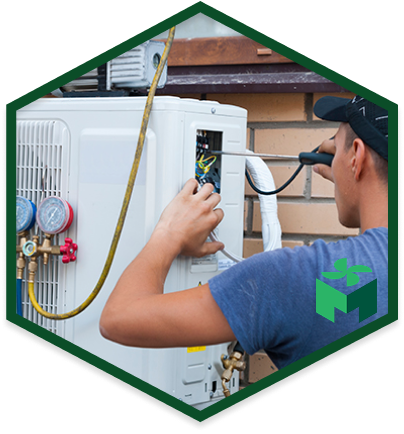
Your Path to Comfort: Our Mini Split Installation Process
Installing a ductless system is significantly less invasive than installing central air, but it requires technical precision to ensure longevity and efficiency. We follow a strict protocol to ensure your system performs perfectly from day one.
Site Evaluation and Load Calculation
Before any equipment is ordered, we determine exactly what your space requires.
- We perform a Manual J load calculation to determine the necessary BTU capacity.
- Technicians assess wall space to find the optimal mounting location for airflow and drainage.
- We locate the best position for the outdoor condenser unit to ensure it has adequate clearance and is protected from potential floodwaters or debris.
Mounting the Indoor Unit
The indoor air handler must be level and secure.
- Technicians install a mounting plate reinforced to handle the weight of the unit.
- We drill a small, roughly three-inch hole through the exterior wall for the refrigerant lines, control wiring, and drain hose.
- The unit is mounted securely, ensuring it sits flush against the wall for a clean aesthetic.
Running the Line Set
The connection between the indoor and outdoor units is the lifeline of the system.
- We run insulated copper refrigerant lines through the wall penetration to the outdoor unit.
- A condensate drain line is installed to gravity-feed moisture away from the home.
- If gravity drainage is not possible due to the unit’s location, a condensate pump is installed to mechanically remove water.
- All lines are covered with line hide or conduit on the exterior of the home to protect them from the sun and weather, ensuring a neat appearance.
Electrical and Outdoor Setup
The outdoor condenser does the heavy lifting and requires specific electrical setups.
- We pour or place a concrete or composite pad to keep the condenser off the ground.
- In areas prone to higher water levels, we may use wall brackets or elevated stands.
- A dedicated electrical circuit is run from your main panel to a disconnect box near the outdoor unit, adhering to all local electrical codes.
- Control wires are connected between the indoor and outdoor units to facilitate communication.
System Testing and Commissioning
We never leave until the system is proven to work.
- Technicians perform a nitrogen pressure test to check for leaks in the refrigerant lines.
- A vacuum pump is used to remove all moisture and air from the lines before releasing the refrigerant.
- We power up the system, check the temperature differential (delta T) between intake and exhaust air, and verify that all zones are responding to the remote control.
Deciding Between AC Repair or Full Replacement
Homeowners often face the dilemma of sinking money into an aging system or biting the bullet for a new installation. Understanding when to repair and when to replace is key to financial prudence.
When to Choose Repair
Repair is often the right choice for newer systems or minor issues.
- The system is under ten years old and generally well-maintained.
- The issue is a simple component failure, such as a capacitor, fan motor, or control board.
- The cost of the repair is less than 50% of the value of a new system — view our pricing.
- The system still uses a modern refrigerant (R-410A) rather than phased-out types.
When to Choose Replacement
There comes a point where repair is throwing good money after bad.
- Age of Unit: If your current unit is over 15 years old, it is likely nearing the end of its compressor life.
- Refrigerant Leaks: If an older system is leaking refrigerant, finding and fixing the leak plus recharging the system is expensive and often temporary.
- Compressor Failure: The compressor is the heart of the system. If it fails on an out-of-warranty unit, a full replacement is almost always more cost-effective.
- Inefficiency: If your energy bills are skyrocketing despite normal usage, the unit’s efficiency has likely degraded significantly.
- Frequent Breakdowns: If you have called for repairs more than twice in the last year, the system is unreliable.
The Mini Split Advantage in Replacement
If you are replacing a window unit or adding cooling to a room addition, a mini split is superior.
- It provides permanent cooling without blocking a window, which improves security and aesthetics.
- It operates much quieter than window units, which creates a better sleep environment.
- It adds value to the home, whereas window units do not.
Local Insights: Navigating Dickinson’s Climate with the Right Mini Split System
Operating an HVAC system in Dickinson requires specific considerations due to the local climate and geography. The proximity to the Gulf of Mexico introduces factors that generic installations often overlook.
Combating Salt and Corrosion
The coastal air contains higher salt content, which can accelerate corrosion on outdoor condenser coils.
- We recommend units with anti-corrosive coatings on the fins and coils.
- Regular maintenance plans are essential to wash down the outdoor units and remove salt buildup before it eats through the metal.
- Elevating units slightly helps prevent splash-back from heavy rains that might carry corrosive soil or debris.
Hurricane Season Preparation
Late summer and early fall bring the threat of hurricanes and tropical storms.
- Outdoor units must be anchored securely to their pads or wall brackets to withstand high winds.
- We ensure that line sets are firmly strapped down so they do not whip around and fracture during a storm.
- Installing the unit on a stand specifically designed for wind loading provides extra peace of mind during turbulent weather.
Permitting and HOAs
Local regulations in Dickinson affect where and how units can be installed.
- Most installations require an electrical and mechanical permit to ensure safety compliance.
- We handle the permitting process, ensuring that the work passes inspection by city officials.
- If you live in a neighborhood with a Homeowners Association (HOA), there may be restrictions on the visibility of the outdoor unit or the line sets. We work with you to find placement options that satisfy these rules while maintaining system efficiency.
Dealing with High Heat Loads
The average highs of 90-95°F require systems that do not de-rate significantly at high temperatures.
- We size units based on the “design temperature” of the region, ensuring the system can keep up on the hottest day of the year.
- Undersized units will run constantly, failing to dehumidify effectively and driving up energy costs.
- Mackey Services ensures that the BTU output matches the heat gain of your specific room, accounting for window exposure and insulation levels.
Why Choose Us? Proven Reliability and Local Expertise
Selecting a contractor for your mini split installation is just as important as selecting the brand of the equipment. An improper installation can reduce the efficiency of a top-tier unit by up to 30%. We prioritize technical excellence and transparent service — read our reviews.
Authorized Dealers for Top Brands
We work with industry leaders like Mitsubishi and Daikin.
- These brands are pioneers in inverter technology and offer some of the highest reliability ratings in the market.
- As authorized installers, we have access to specific training and technical support that general handymen do not.
- This relationship often allows us to offer extended warranties that protect your investment for longer periods.
Technical Precision
Mini splits require specialized tools and knowledge.
- Flaring copper tubing for ductless connections requires a precise torque setting; too tight and it cracks, too loose and it leaks. Our technicians use digital torque wrenches to ensure factory-spec connections.
- We utilize micron gauges during the vacuum process to scientifically prove the system is free of moisture, rather than guessing based on time.
- Our electrical work is performed to code, ensuring that your new system does not overload your home’s existing circuitry.
Transparent Pricing and Process
We believe in no-surprise service.
- You receive a detailed quote outlining the equipment, labor, and materials required.
- We explain the difference between single-zone and multi-zone options, helping you choose the setup that fits your budget and cooling needs.
- We assist with identifying available rebates from local utilities or manufacturers that can lower the upfront cost of high-efficiency units.
Post-Installation Support
Our relationship does not end when the unit turns on.
- We walk you through the operation of the remote control, showing you how to use features like “Follow Me,” timers, and vane oscillation.
- We offer maintenance plans to clean filters, check refrigerant levels, and flush drain lines, preventing common issues like water leaks or mold growth.
- Local support means if you have an issue, we are nearby and ready to respond, not a distant call center.
Upgrading to a mini split system transforms how you experience comfort in your home. whether you are looking to cool a garage, a new addition, or your entire house, the efficiency and quiet operation of these systems are unmatched. Trust Mackey Services to handle your installation with the expertise your home deserves.