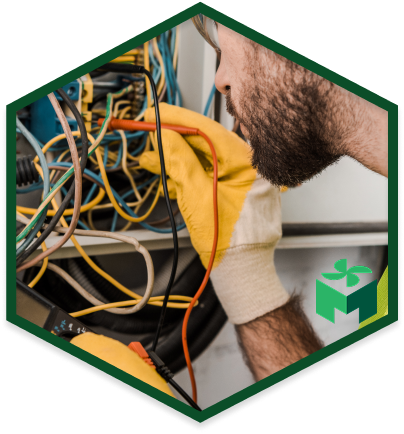
The Rewiring Installation Process
Understanding the workflow of a rewiring project helps homeowners prepare for the work ahead. While rewiring is a major construction task, professional teams work to minimize disruption to your daily life. The goal is to execute the upgrade with surgical precision, limiting the need for drywall patch-and-paint work wherever possible.
The process generally follows a specific sequence to ensure safety and code compliance:
- Initial Assessment and Mapping: The team performs a load calculation to determine the necessary service size. They map out the existing circuits and identify the most efficient routes for running new non-metallic (NM) cable.
- Permitting and Disconnection: Before work begins, proper permits are pulled from local building authorities. Power is disconnected safely to ensure the work area is hazard-free.
- Access and Preparation: Technicians create small, strategic access points in walls and ceilings. This allows for the “fishing” of wires without tearing down entire walls. Floor protection and dust containment measures are deployed to protect furniture and flooring.
- Rough-In Phase: New wiring is pulled from the main panel location to every device box in the house. This includes drilling through studs and joists to route cables securely.
- Device Installation: Once the wiring is in place, new outlets, switches, and fixtures are connected. The main service panel is installed and populated with new breakers.
- Inspection and Testing: A rigorous internal audit is conducted to verify polarity, grounding, and tension on all connections.
- Final Inspection and Activation: The local electrical inspector reviews the work to ensure it meets all safety codes. Once passed, power is restored, and the system is energized.
When Full Replacement Beats Repair
Homeowners often hesitate between repairing specific issues and committing to a full rewire. While spot repairs can fix immediate frustrations, they often mask deeper systemic failures. In many older properties, the insulation on the wires has degraded due to decades of heat cycles, making the wires brittle and prone to arcing.
A full replacement is the financially and structurally sound choice in the following scenarios:
- Aluminum Wiring Presence: If a home was built between the mid-60s and early 70s, it may contain aluminum wiring. This material expands and contracts more than copper, leading to loose connections and high fire risk. Retrofitting is a temporary stop-gap; replacement is the permanent cure.
- Lack of Grounding: If outlets only have two prongs, there is no ground wire. Using adapters does not solve the safety issue. Electronic equipment and modern appliances require a ground for safe operation.
- Cloth-Insulated Wiring: Homes built before 1950 often rely on cloth insulation that cracks and flakes off, exposing bare live wires inside walls. This is an immediate fire hazard that cannot be repaired, only replaced.
- Persistent Breaker Tripping: If lights flicker when the AC turns on, or if breakers trip daily, the system is overloaded. Adding a new breaker to an old panel does not increase the service entry capacity coming from the utility.
- Renovation Plans: If you are planning a kitchen or bath remodel, current codes require that the electrical in those areas be brought up to modern standards. It is far more cost-effective to rewire during the renovation when walls are already open — view our specials.
Continuing to patch an obsolete system often costs more over time in emergency service calls and potential damage to expensive electronics than a proactive rewire.
Local Considerations and Code Compliance
Electrical work in Texas is governed by strict regulations designed to handle the region’s specific environmental challenges. The combination of extreme summer heat and occasional freezing winter temperatures places a unique strain on electrical grids and residential wiring.
- Permits and Inspections: All whole-home rewiring projects require a permit from the city or county. The Texas Department of Licensing and Regulation (TDLR) oversees the licensing of electricians, ensuring that only qualified professionals handle these complex high-voltage systems. Inspections are mandatory to close out the permit, providing an official record that the home meets safety standards.
- Load Calculations for Climate: In this region, air conditioning is a life-safety requirement, not just a luxury. Wiring must be sized correctly to handle the continuous draw of HVAC units running at peak capacity during heatwaves. Undersized wiring creates resistance, which generates heat—the last thing a home needs during a Texas summer.
- Grid Integration: As the Texas grid integrates more renewable energy sources, voltage fluctuations can occur. Modern residential systems are better equipped to handle these variations or can be easily fitted with whole-home surge protection to guard against grid instability.
- Insurance Requirements: Many insurance carriers in the area will refuse to write policies for homes with knob-and-tube or unmodified aluminum wiring. Providing proof of a professional rewire can lower premiums and ensure coverage eligibility.
Proof of Quality and Safety
Safety is the primary metric of success in electrical work. A proper rewire eliminates the “electrical noise” that interferes with audio/video equipment and provides a stable, clean power supply for smart home automation.
Professional execution involves using high-quality materials that exceed minimum code requirements. This includes using copper wiring exclusively for branch circuits, utilizing commercial-grade panels with bus bars rated for high conductivity, and ensuring every junction box is accessible and properly secured.
We ensure that the finished product is not just functional but tidy. Panels are labeled clearly, wires are organized and stapled neatly, and debris is removed entirely. The investment in a rewire is significant, and the craftsmanship should reflect that value — read customer reviews.