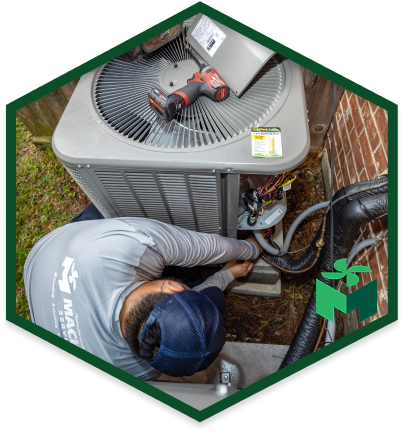
Our Heat Pump Service Offerings – Efficiency You Can Feel
We provide a holistic approach to heat pump care. Our services are divided into two main categories: restorative repairs for existing systems and comprehensive installation for homes requiring a system upgrade.
Precision Diagnostics and Repair
Modern heat pumps are complex machines involving advanced electronics and variable-speed motors. A standard “freon fill” is rarely the solution to a real performance issue. We dig deeper to analyze the entire refrigerant cycle.
- Reversing Valve Troubleshooting: The component that distinguishes a heat pump from a standard AC is the reversing valve. If this sticks, your system cannot switch modes. We test and replace faulty valves to restore dual-functionality.
- Compressor Analysis: The compressor is the heart of the system. We measure amperage draw and pressure levels to detect early signs of failure before a complete breakdown occurs.
- Auxiliary Heat Testing: During extreme cold snaps, your heat pump relies on emergency heat strips. We verify these electrical resistance heaters engage correctly so you aren’t left shivering when the temperature drops below freezing.
- Airflow and Static Pressure: Restricted airflow kills efficiency. We assess your ductwork and blower motor to ensure the system isn’t suffocating, which extends the life of the equipment.
High-Performance Installation
Installation is the most critical day in the life of a heat pump. A poor installation will reduce efficiency by up to 30%.
- Load Calculations: We perform rigorous calculations based on your home’s insulation, windows, and orientation. We do not guess sizes based on square footage alone.
- Ductwork Modification: Heat pumps often require different airflow rates than gas furnaces. We assess and modify plenums and ductwork to accommodate the specific static pressure requirements of the new unit.
- Smart Thermostat Integration: To get the most out of a variable-speed heat pump, you need a communicating thermostat. We install and calibrate controls that manage humidity and temperature with precision.
Your Installation Journey – A Step-by-Step Guide
Replacing a central heating and cooling system is a significant project. We believe in transparency, so you know exactly what happens from the moment our trucks arrive at your Pearland property until the final test run.
- Site Evaluation and Sizing:
First, technicians conduct a Manual J load calculation. This engineering standard ensures the new unit is sized perfectly for the heat gain and loss of your specific structure. Oversized units short-cycle and fail to dehumidify, while undersized units run constantly without reaching the set temperature.
- Safe Removal and Disposal:
Next, the crew isolates the electrical disconnect and pumps down any remaining refrigerant in the old unit according to EPA regulations. The old equipment is removed, and we ensure the installation pad is leveled or replaced to support the new, heavier outdoor condensers typical of high-efficiency systems.
- Indoor and Outdoor Unit Installation:
Then, the indoor air handler and outdoor condenser are set in place. For heat pumps, specific attention is paid to the “snow leg” or stand height on the outdoor unit to prevent debris or potential ice accumulation from blocking airflow at the base.
- Line Set and Electrical Connection:
Technicians braze the copper refrigerant lines using nitrogen purging to prevent oxidation inside the pipes. High-voltage wiring is connected to a new disconnect box, and low-voltage control wires are routed to the thermostat.
Before starting the system, a deep vacuum is pulled on the lines to remove all moisture and non-condensables. This is critical for preventing acid formation in the compressor. The system is then charged with the precise amount of refrigerant specified by the manufacturer.
Finally, the system is powered on. Technicians measure static pressure, temperature split, and amperage to verify the unit is operating within factory specifications. We walk you through the new thermostat operations and maintenance requirements.
Deciding Between Repair and Replacement: What You Need to Know
Homeowners often struggle with the financial decision of whether to sink money into a repair or invest in a new system. While we are happy to repair any system that can be fixed safely, there are mathematical and practical tipping points where replacement becomes the smarter financial move.
The Age Factor and Refrigerant Types
If your heat pump is over 10 to 12 years old, it is approaching the end of its useful service life. Systems manufactured before 2010 likely utilize R-22 refrigerant, which has been phased out and is now prohibitively expensive to restock. If an older R-22 system develops a leak, the cost of the refrigerant alone often covers a significant down payment on a modern R-410A or R-454B system.
The 50% Rule
A general guideline in the industry is the 50% rule. If the cost of the necessary repair approaches 50% of the value of the system (or the cost of a new unit), replacement is usually the better option. For example, replacing a compressor on a 12-year-old unit is rarely worth the investment because other components, like the coil or blower motor, are likely to fail soon after.
Frequency of Breakdowns
Reliability has a value. If you have required repairs more than twice in the last two years, your system is signaling that it is deteriorating. Continuous repairs add up quickly, often exceeding the monthly cost of financing a new, high-efficiency system that comes with a fresh warranty.
Energy Efficiency Gains
Heat pump technology has advanced rapidly. Older units may have a SEER rating of 10 or 12. Modern systems start at SEER2 14.3 and go up to 20+. Upgrading from a 10 SEER to a 16 SEER system can reduce your cooling costs by nearly 40%. Additionally, modern heat pumps have higher HSPF2 (Heating Seasonal Performance Factor) ratings, meaning they are much more efficient at heating your home without relying on expensive auxiliary electric heat strips.
Local Insights – Adapting to Texas’s Unique Climate
Operating a heat pump in this region requires specific configurations to handle our extreme weather variance. While we don’t see sub-zero temperatures often, the humidity in our area presents a unique challenge that generic installation practices often miss.
Managing High Humidity
In our region, removing humidity is just as important as lowering the temperature. If a heat pump is slightly oversized, it will cool the house too quickly and shut off before it has removed the moisture from the air. This leads to a “clammy” feeling and potential mold growth. We prioritize matching the system to the latent heat load (humidity) of your home, often recommending two-stage or variable-speed compressors that run longer at lower speeds to actively dehumidify the air.
The Importance of Auxiliary Heat
While heat pumps are efficient, they lose capacity as the outdoor temperature drops toward freezing. Given the occasional severe winter storms we experience, relying solely on the heat pump cycle can be risky. We ensure that your system is equipped with properly sized electric heat strips (auxiliary heat). These engage automatically when the heat pump cannot keep up or goes into defrost mode. Properly staging these strips is vital; if they come on too early, your energy bill skyrockets. If they don’t come on at all, you freeze. Mackey Services configures your thermostat to balance efficiency with safety during these cold snaps.
Permits and Compliance
Local municipalities have strict codes regarding HVAC installations to ensure safety and energy conservation. This includes requirements for breaker sizing, wire gauges, and disconnect accessibility. We handle all necessary permitting and ensure that every installation meets local building codes and manufacturer specifications. This protects your home’s value and ensures your insurance coverage remains valid.
Why Choose Us? – Trusted in Texas for Decades
When you invite a service provider into your home, you need to know they have the technical expertise and the professional integrity to do the job right. We don’t just swap boxes; we engineer comfort solutions.
Our team comprises NATE-certified technicians who have undergone rigorous testing in heat pump technology. We understand the physics of thermodynamics and the intricacies of modern control boards.
We treat your property with the highest level of respect. Our technicians use shoe covers and drop cloths to protect your flooring. We maintain a clean job site and haul away all debris and old equipment, leaving your home as clean as we found it.
- Transparent Communication:
You will never be surprised by a bill. We provide clear, upfront explanations of the work required and the associated costs before we turn a wrench. Whether it is a simple capacitor replacement or a full system retrofit, you remain in control of the process.
We stand behind our workmanship. In addition to manufacturer warranties on parts, we offer robust labor warranties. If an issue arises related to our installation, we return to fix it. We also assist in registering your equipment to ensure you receive the maximum warranty coverage available.
Your home comfort system is too important to leave to chance. Whether you are looking to upgrade to a high-efficiency heat pump or need urgent repairs to get through the season, we have the tools and talent to deliver results.