Understanding Our Electrical Repair Process
Professional electrical repair requires a methodical approach to ensure safety and code compliance. We do not guess; we follow a strict protocol that protects your home and ensures the longevity of the repair. From the moment a technician arrives at your location, the focus is on accuracy and efficiency.
Our service workflow is designed to minimize disruption while maximizing safety:
- Initial Site Assessment: The technician begins by listening to your observations and conducting a visual inspection of the affected area. This includes checking the main panel for signs of stress or previous sub-par modifications.
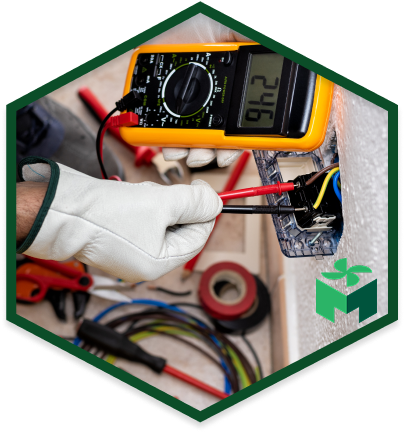
- Testing and troubleshooting: Using multimeters and circuit analyzers, we test voltage levels, amperage draw, and continuity. This data allows us to pinpoint exactly where the breakdown has occurred, whether it is a specific device or a wiring run inside the walls.
- Clear Explanation and Quote: Before any tool is applied for repair, you receive a detailed explanation of the problem and a firm price for the solution. You will understand exactly what is being fixed and why.
- Execution of Repair: The technician isolates the circuit to ensure a safe work environment and proceeds with the repair using high-quality, code-compliant materials.
- System Verification: After the repair is complete, we re-energize the circuit and test all connected devices. We verify that the voltage is stable and that the issue is fully resolved under load.
- Clean Up and Review: We remove all debris, wire clippings, and old components. The technician walks you through the completed work to ensure you are satisfied with the restoration of power.
Deciding Between Repair and System Upgrades
Homeowners often face the decision of whether to repair a specific component or upgrade a portion of their electrical system. This decision typically hinges on the age of the home, the condition of the existing equipment, and current power demands. While a repair addresses the immediate symptom, an upgrade is often necessary to prevent recurring issues, especially in older properties found throughout Dickinson.
The age of your electrical panel is a primary factor. If your home still utilizes a fuse box or an outdated panel brand known for safety failures (such as Federal Pacific or Zinsco), repair is rarely the safe option. In these instances, the internal mechanisms may no longer trip effectively during a surge, posing a significant fire risk. Replacing the panel is the only way to ensure the safety of the household.
Wiring material also dictates the path forward. Homes built between the mid-1960s and mid-1970s may contain aluminum wiring. Aluminum expands and contracts more than copper, leading to loose connections and potential arcing. While specific connectors can sometimes repair these connections, a partial or full rewire is often the recommended long-term solution for safety.
Consider an upgrade over a repair in the following scenarios:
- Insufficient Amperage: If your main service is 60 or 100 amps and you are adding modern appliances like HVAC units or EV chargers, the panel cannot support the load. A service upgrade to 200 amps is required.
- Lack of Grounding: Two-prong outlets indicate a lack of grounding wire. repairing the outlet does not add safety; rewiring the circuit to include a ground is necessary for modern electronics.
- Recurring Surges: If you experience frequent bulb blowouts or appliance failures, a simple repair won’t suffice. You likely need a whole-home surge protector or a panel upgrade to stabilize voltage.
- Scorched Components: Physical damage to the panel bus bar or melted insulation usually requires replacement of the affected unit rather than a component swap.
Mackey Services technicians provide honest assessments, helping you weigh the immediate cost of repair against the long-term value and safety of an upgrade — explore financing options today.
Regional Considerations for Electrical Services in Dickinson
Operating an electrical system in Dickinson, TX, requires specific attention to environmental factors that do not affect other regions as severely. The local climate significantly impacts the longevity and performance of electrical components. High humidity levels, characteristic of the region, accelerate corrosion on outdoor service drops, meter cans, and even indoor panels located in unconditioned spaces like garages.
Seasonality also dictates electrical load. During the hot summers, air conditioning units run almost continuously, drawing near-maximum amperage for hours at a time. This sustained load can overheat older breakers and loosen connections within the panel. Regular inspection of these high-draw circuits is essential to prevent mid-summer failures.
Storm safety is another critical consideration for the area. The prevalence of heavy rainfall in May and September, combined with the risk of tropical storms, increases the likelihood of water intrusion into electrical systems.
Local factors impacting your electrical decisions include:
- Flood Risks: Electrical outlets and wiring located near floor level in flood-prone zones may need to be inspected or relocated if water has entered the home. Saltwater exposure requires the immediate replacement of all affected electrical components.
- Surge Protection: Lightning storms are frequent. Installing whole-home surge protection at the panel level defends sensitive electronics and appliances from voltage spikes common during local thunderstorms.
- Code Compliance: Local building codes in Dickinson are strict regarding safety upgrades during renovations. If you are remodeling, you may be required to bring the entire room’s electrical up to current NEC standards, including the installation of AFCI protection.
- Generator Integration: Due to the potential for weather-related power outages, many residents opt for transfer switches or interlock kits. These must be installed by professionals to prevent back-feeding the grid, which endangers utility workers.
Technical Precision and Safety Protocols
Electrical work is precise. A loose connection can create high resistance, which generates heat—the precursor to an electrical fire. Our technicians are trained to identify these subtle warning signs that often go unnoticed by general handymen. We utilize thermal imaging and voltage drop testing to ensure that the flow of electricity in your home is efficient and safe.
We also focus on the specific requirements of modern appliances. Today’s washing machines, refrigerators, and computers are sensitive to “dirty power” or unstable voltage. Ensuring your neutral and ground wires are intact is critical for the lifespan of these expensive devices. We verify that your bonding system is correct, which directs stray electrical current safely into the earth rather than through your appliances or piping.
Safety protocols we strictly enforce include:
- Lockout/Tagout Procedures: Ensuring circuits are dead before work begins.
- Load Calculation: Verifying that a new circuit will not overload the panel.
- Arc Fault Detection: Installing mandated AFCI breakers in living areas to detect dangerous sparking.
- Ground Fault Protection: Ensuring wet areas (kitchens, baths, garages) have functioning GFCI protection.
Why Professional Execution Matters
Choosing a service provider involves looking beyond the immediate fix and considering the long-term safety of your home. Electrical systems are strictly regulated for a reason: mistakes can be lethal. We operate with full licensing, ensuring that every technician has undergone rigorous training and background checks. This expertise translates to faster troubleshooting and repairs that pass inspection the first time.
We handle the logistical side of repairs as well. If a repair requires a permit from the city or coordination with the local utility company to disconnect power at the pole, we manage those communications. You are not left navigating municipal bureaucracy; we ensure the job is filed, inspected, and closed out properly.
Our commitment extends to the quality of parts we use. We do not source inferior breakers or receptacles that are prone to early failure. We install commercial-grade components designed to withstand the thermal cycling and humidity typical of the Dickinson area. When we leave your home, the repair is integrated seamlessly into your existing system, labeled clearly, and tested for reliability.
Electrical issues do not resolve themselves; they only escalate. Delaying a necessary repair can lead to total power loss or significant property damage. Secure your home’s electrical integrity with a team that values precision, safety, and local expertise.
Contact us online to book your electrical repair service now.