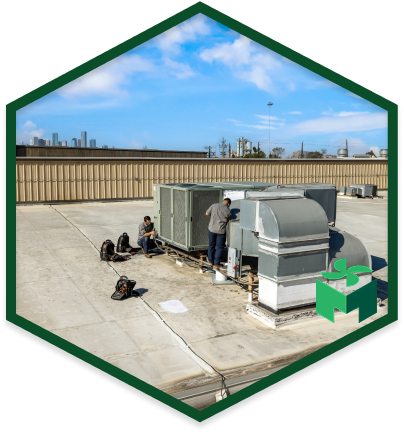
The Installation and Replacement Process
When a repair is no longer feasible, a systematic replacement process ensures your new equipment meets the specific demands of your building. This is not a swap-and-go operation; it requires engineering and planning to match the equipment to the heat load of your specific commercial footprint.
- Site Evaluation and Load Calculation: The process begins with a thorough evaluation of the facility. Technicians perform load calculations that factor in square footage, ceiling height, occupancy levels, heat-generating equipment, and window exposure. This step ensures the selected unit has the correct tonnage to cool the space without short-cycling, which causes premature wear.
- System Selection and Engineering: Based on the load calculation, the appropriate system is selected. This involves choosing between standard efficiency units or high-efficiency models with higher SEER and IEER ratings. At this stage, decisions regarding zoning capabilities and building automation integration are made to maximize future energy savings.
- Safe Removal and Disposal: The old equipment is disconnected and removed safely. In commercial settings, this often involves coordination with crane services to lift heavy RTUs from the roof. Refrigerant is recovered according to EPA guidelines to prevent environmental contamination and ensure legal compliance.
- Professional Installation: The new unit is set in place. Technicians connect the electrical lines, condensate drains, and ductwork transitions. If the new unit footprint differs from the old one, curb adapters are installed to ensure a watertight seal on the roof.
- Testing, Balancing, and Commissioning: Once the physical installation is complete, the system undergoes rigorous testing. Technicians balance the air distribution to ensure every zone receives the correct amount of airflow. The system is started, and performance data is logged to verify it is operating within manufacturer specifications before the job is marked complete.
Critical Decision Guide: Repair vs. Replace
Making the financial decision to repair an aging asset or invest in a new system is a common challenge for facility managers. While repairs offer a lower immediate cost, they can become a financial drain if the system is nearing the end of its useful life. Mackey Services assists in navigating this decision by providing data-backed assessments of your current equipment’s health.
- The 50% Rule: A standard metric in commercial HVAC is the 50% rule. If the cost of a necessary repair approaches or exceeds 50% of the value of a new system, replacement is generally the smarter financial move. Investing heavy capital into a degrading asset often leads to diminishing returns as other components inevitably fail shortly after the repair.
- Equipment Age and Reliability: Commercial systems typically last between 15 and 20 years, depending on maintenance history and operating conditions. If your unit is over 15 years old and requires a major component replacement, such as a compressor or heat exchanger, replacement is usually recommended. Newer units offer significant efficiency gains that can offset the installation cost over time through lower utility bills.
- Frequency of Breakdowns: If your maintenance log shows repeated service calls for the same unit over the past 12 months, the system has likely become unreliable. Frequent breakdowns disrupt business and frustrate occupants. Replacing a “lemon” or a severely worn-out unit eliminates unpredictable repair costs and stabilizes your facility management budget.
- Energy Efficiency Limitations: Older units often utilize phased-out refrigerants like R-22 and operate at lower efficiency standards. If your energy bills are steadily climbing despite normal usage, the equipment has likely lost its ability to transfer heat effectively. Upgrading to modern standards can drastically reduce monthly operating expenses.
Local Factors Impacting HVAC in This Region
Operating a commercial HVAC system in this part of Texas requires specific attention to environmental factors that do not affect other regions. The climate here is characterized by intense heat combined with high humidity, which places a unique strain on cooling equipment. Standard air conditioning involves both removing heat (sensible load) and removing moisture (latent load). In this area, the latent load is substantial.
- Humidity Control and Dehumidification: Because of the high moisture content in the air, commercial systems must be sized correctly to run long enough to dehumidify the space. Oversized units will cool the air too quickly and shut off before removing humidity, leading to a “clammy” indoor environment and potential mold growth. Many local businesses benefit from dedicated dehumidification systems or reheat circuits that allow the HVAC system to remove moisture without overcooling the space.
- Corrosion and Coastal Influence: While not directly on the beach, the regional air can still accelerate corrosion on condenser coils and outdoor components. It is vital to monitor coils for oxidation and degradation. specialized coatings are often recommended for new installations to extend the life of the aluminum fins and copper tubing found in outdoor units.
- Permitting and Code Compliance: Commercial HVAC work requires strict adherence to local building codes and safety standards. This includes proper ventilation rates (ASHRAE standards) to ensure fresh air intake for occupants. Electrical connections must meet the National Electrical Code (NEC), and all structural modifications to roofs for RTU support must be permitted. Failing to secure proper permits can lead to fines and issues with insurance coverage.
- Seasonal Maintenance Requirements: The cooling season is long, often extending from early spring into late autumn. This results in higher run hours compared to national averages. Consequently, filter changes and belt replacements must happen more frequently. The mild winters mean heating is used less, but gas furnaces or electric heat strips still require annual safety checks to prevent carbon monoxide issues or fire hazards during the few freeze events that occur.
Why Professional Management Protects Your Assets
Your HVAC system is likely one of the most expensive assets attached to your commercial property. proper management of this asset shifts the dynamic from reactive emergency spending to proactive investment protection. Professional service ensures that warranty requirements are met; most manufacturers require proof of regular maintenance to honor parts warranties.
Beyond warranty compliance, a well-tuned system contributes to the productivity of your workforce. Studies consistently show that poor indoor air quality and uncomfortable temperatures lead to distraction and lower output. For retail and hospitality businesses, the customer experience is directly tied to comfort. If a store is hot and humid, customers leave.
Competent commercial service providers understand the intricacies of commercial setups, from single-phase light commercial units to three-phase industrial grade systems. They utilize digital tools to track the history of every unit, ensuring that no issue is overlooked. By partnering with a dedicated service team, you secure the longevity of your equipment and the comfort of your building.
Ensure your business remains operational and comfortable regardless of the weather outside. Secure your commercial HVAC needs with a team that prioritizes speed, accuracy, and long-term performance — contact us today. Take control of your facility’s climate today.