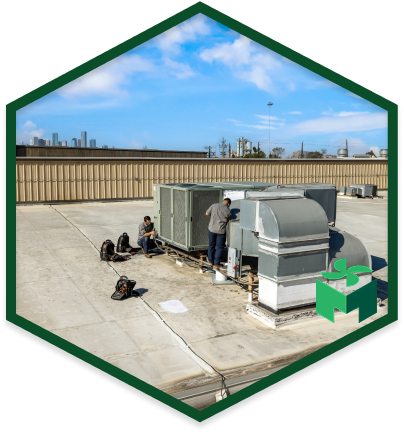
The Commercial Installation and Replacement Process
Executing a commercial HVAC installation requires detailed planning and coordination to ensure safety and adherence to timeline constraints. We approach every installation as a construction project, requiring logistical precision and technical expertise. The process is designed to result in a system that performs at peak efficiency from day one.
The installation workflow follows a strict set of protocols:
- Site Assessment and Load Calculation: Before any equipment is ordered, we perform a Manual N commercial load calculation. This accounts for the square footage, window placement, insulation values, and internal heat gains from lights, computers, and people. This step ensures the unit is neither undersized (causing constant running) nor oversized (leading to short-cycling and humidity issues).
- System Selection and Engineering: We select equipment that meets the specific Seasonal Energy Efficiency Ratio (SEER) and Energy Efficiency Ratio (EER) requirements suited for the region. We also evaluate the existing ductwork to determine if modifications are necessary to handle the airflow of the new unit.
- Safe Removal and Disposal: For replacement projects, we safely reclaim existing refrigerant according to EPA guidelines and dismantle the old unit. We handle the logistics of crane rentals for rooftop units, ensuring the safety of the site and the building structure.
- Installation and Connection: The new unit is positioned, and connections are made for electrical, gas (if applicable), and condensate lines. We pay special attention to the roof curb and flashing to prevent future water leaks, a common issue with improper RTU installations.
- Commissioning and Testing: Once installed, we do not simply turn it on and leave. We perform a full system start-up. This involves checking static pressure, measuring airflow across the evaporator coil, and verifying refrigerant charge (subcooling and superheat). We balance the air distribution registers to ensure even cooling throughout the facility.
- Final Handover: We walk your facility manager through the operation of the new thermostat or building automation system, ensuring you have full control over your climate settings.
Deciding Between Commercial Repair or System Replacement
Determining whether to inject more capital into an aging system or invest in a new unit is a financial decision that impacts your bottom line. While repairs often seem like the cheaper immediate option, they can lead to higher cumulative costs if the unit is nearing the end of its service life. We help business owners in League City navigate this decision using data and industry-standard metrics rather than guesswork.
One effective metric we use is the “5,000 Rule.” You multiply the age of the equipment by the estimated repair cost. If the total exceeds $5,000, replacement is generally the more financially sound investment. For example, if you have a 12-year-old unit requiring a $500 repair, the score is 6,000, suggesting that replacement is the better long-term strategy.
Additional factors to weigh include:
- Frequency of Breakdowns: If your business has required multiple service calls in the last 12 months, the system is likely entering a phase of diminishing returns. Constant repairs disrupt your business and indicate that major components are failing sequentially.
- Energy Efficiency Performance: Older commercial units often have significantly lower EER ratings compared to modern systems. If your utility bills are rising despite consistent usage, Mackey Services can calculate the Return on Investment (ROI) for a high-efficiency replacement. Modern systems often pay for themselves over time through reduced energy consumption.
- Refrigerant Type: Many older systems utilize R-22 refrigerant, which has been phased out and is incredibly expensive to source. If your R-22 system develops a leak, the cost of the refrigerant alone may justify upgrading to a system that uses R-410A or newer, eco-friendly alternatives.
- Comfort Complaints: If certain areas of your building are consistently too hot or too cold, or if humidity levels are uncontrollable, the current system may no longer be capable of meeting the building’s load requirements. This often happens when internal office layouts change without updating the HVAC infrastructure.
Managing HVAC Requirements in the Local Climate
Operating commercial HVAC equipment in this region presents unique challenges due to the specific climate profile. The combination of high ambient temperatures and significant humidity levels creates a heavy workload for cooling systems. In humid subtropical zones like East Texas, the air conditioner does not just cool the air; it serves as a critical dehumidifier. If a system is short-cycling or not operating at peak capacity, humidity levels inside the building will spike. High indoor humidity can lead to mold growth, “sweating” ducts that damage ceiling tiles, and a clammy, uncomfortable environment for customers and staff.
To combat these local challenges, we emphasize:
- Condensate Management: Commercial units produce gallons of water daily during the summer. We ensure condensate drain lines are properly trapped, insulated, and routed to prevent blockages that can lead to water damage. We also install float switches to shut the system down if a backup is detected.
- Economizer Calibration: Many commercial RTUs are equipped with economizers that use fresh outdoor air for cooling when conditions are mild. However, given the local humidity, these must be calibrated precisely. Incorrect settings can pull in moisture-laden air, overwhelming the system. We adjust enthalpy controls to ensure outdoor air is only used when it actually benefits the building’s internal climate.
- Corrosion Protection: For businesses located nearer to the coast or industrial areas, salt and pollutants in the air can corrode condenser coils. We offer coil coating services and recommend units built with corrosion-resistant materials to extend the lifespan of the equipment.
Compliance and Permitting
Commercial HVAC work is strictly regulated to ensure safety and energy conservation. Any significant repair or replacement requires adherence to the Texas Building Energy Performance Standards (TBEPS). These standards mandate specific efficiency ratings and programmable thermostat capabilities for commercial buildings. Furthermore, local municipalities often require permits for crane operations and structural modifications associated with roof-mounted units. Our team handles the administrative burden of permitting, ensuring that your project proceeds without legal or regulatory delays. We ensure your facility meets all ASHRAE ventilation standards, which is critical for maintaining healthy indoor air quality (IAQ) in sealed commercial buildings.
Why Businesses Choose Our Technical Team
Selecting a mechanical contractor is a partnership. You need a team that acts as an extension of your facilities management, providing transparent communication and technical excellence. We differentiate ourselves through a commitment to data-driven service and long-term reliability. We do not offer band-aid fixes; we provide engineered solutions designed to last.
Our technicians are certified and undergo continuous training to stay ahead of advancements in VRF technology, building automation, and energy codes. When you work with us, you receive clear documentation of all work performed, including photos of damaged components and detailed explanations of the repairs. This transparency allows you to make informed decisions about your capital expenditures.
We recognize that commercial HVAC is high-stakes. A server room overheating can mean data loss; a restaurant AC failure can mean lost revenue. We prioritize response times and carry a robust inventory of universal commercial parts to aim for first-time fixes. Your business continuity is the priority. Secure your facility’s comfort and efficiency today. Contact our team now to schedule your commercial service or system assessment.