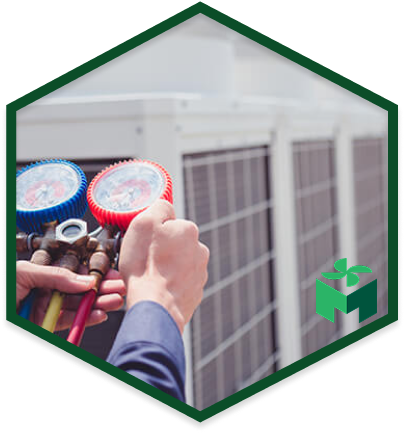
Today’s Services: Immediate, Thorough, and Tailored
When you engage a commercial HVAC provider, you need to know exactly what is included in the scope of work. Effective maintenance is not a walkthrough; it is a rigorous calibration of thermodynamic and electrical performance. We focus on the components that are most susceptible to wear and tear during high-demand periods. The scope of our maintenance visits is comprehensive and documented, ensuring you have a clear record of your asset’s health for insurance and warranty purposes.
Our technicians execute the following critical tasks during a maintenance visit:
- Evaporator and Condenser Coil Cleaning: We chemically clean coils to remove grime, pollen, and industrial debris that act as insulation and prevent proper heat transfer.
- Refrigerant Charge Verification: We measure superheat and subcooling levels to ensure the refrigerant charge is exact; undercharged or overcharged systems work significantly harder to cool the space.
- Electrical Connection Tightening: Loose connections cause voltage imbalances and hot spots that can burn out motors and contactors; we torque all connections to factory specifications.
- Blower and Belt Adjustments: We inspect belts for signs of cracking or glazing and adjust tension to prevent slippage, while also checking blower motor amp draw to ensure it is within rated limits.
- Condensate Drain Line Clearing: We flush and treat drain lines to prevent algae buildup, which causes water leaks that can damage ceiling tiles and inventory.
- Thermostat and Sensor Calibration: We verify that the temperature reading on your controls matches the actual discharge air temperature, ensuring the system isn’t overcooling or undercooling due to sensor drift.
- Lubrication of Moving Parts: We apply specialized lubricants to bearings and motors to reduce friction, heat generation, and electricity usage.
Our Service Process: Fast, Efficient, Transparent
We understand that commercial facilities cannot afford downtime or disruption during business hours. Our process is streamlined to minimize interference with your daily operations while maximizing the depth of the service provided. We utilize a systematic approach that ensures no component is overlooked and that communication remains clear from the initial dispatch to the final report.
- Initial Assessment and Safety Check: upon arrival, the technician checks in with the facility manager and performs a safety perimeter check around the units. This includes verifying disconnect functionality and looking for obvious signs of exterior damage or hazards.
- Performance Baseline Testing: Before making adjustments, we run the system to establish a baseline. We record starting amperage, voltage, and temperature differentials to understand how the unit is currently performing relative to its design specifications.
- Execution of Maintenance Protocol: The technician moves through the checklist of cleaning, tightening, and calibrating. This is the hands-on phase where filters are changed, coils are scrubbed, and electrical components are tested.
- System Retest and Validation: After the maintenance tasks are complete, the system is restarted. We verify that airflow has improved, amp draw has stabilized, and the temperature split (the difference between supply and return air) is within the optimal range for humidity control.
- Reporting and Recommendations: You receive a digital report detailing the work performed, the condition of the equipment, and photos of any worn parts. If a repair is imminent, we provide a quote immediately so you can plan for it rather than reacting to a breakdown later.
Deciding Between Repair and Replacement: A Quick Guide
One of the most difficult decisions a facility manager faces is whether to approve a costly repair or invest in a new system. In the commercial sector, this calculation involves depreciation, tax incentives, and energy efficiency ratios (EER). While Mackey Services aims to prolong the life of your current equipment, there is a mathematical tipping point where repair becomes a financial liability.
Use the following criteria to guide your decision-making process:
- The 50% Rule: If the cost of the necessary repair approaches or exceeds 50% of the value of a new unit, replacement is generally the smarter financial move. This is particularly true if the unit is out of warranty.
- Equipment Age and R-22 Status: Commercial units typically last 15 to 20 years. However, if your unit is over 12 years old and utilizes R-22 refrigerant (which is phased out and expensive to procure), a major failure like a compressor burnout signals that it is time to upgrade to a compliant, R-410A or newer refrigerant system.
- Frequency of Breakdown: If a unit has required repairs more than twice in the last 12 months, it has likely entered the “failure phase.” Continuing to patch it will cost more in emergency service fees and downtime than the monthly financing payment of a new, high-efficiency unit.
- Energy Efficiency Gaps: Older units often have SEER ratings far below modern standards. Replacing a 10 SEER unit with a 16+ SEER unit can result in energy savings that partially offset the cost of installation within the first few years of operation.
Complying with Texas HVAC Standards and Regulations
Managing commercial HVAC in Pearland and the wider region requires strict adherence to local and state regulations. Texas has specific codes regarding energy consumption, refrigerant handling, and ventilation requirements that businesses must follow to avoid fines and ensure safety. Professional maintenance is the primary documentation path to prove compliance with these standards.
- Refrigerant Management (EPA 608): Under federal and state guidelines, the release of ozone-depleting refrigerants is strictly prohibited. Our technicians hold the necessary EPA certifications to handle, recover, and dispose of refrigerants legally and safely. We maintain logs of refrigerant usage which keeps your facility audit-ready.
- Indoor Air Quality (IAQ) Standards: Texas buildings often struggle with “Sick Building Syndrome” due to high humidity and sealed envelopes. ASHRAE standards dictate specific ventilation rates to ensure fresh air intake. Regular maintenance ensures that economizers and dampers are functioning correctly to bring in fresh air without overwhelming the cooling coil with humidity.
- Energy Efficiency Mandates: The Texas Commission on Environmental Quality (TCEQ) and local municipal codes often adopt versions of the International Energy Conservation Code (IECC). This requires commercial systems to maintain functioning programmable thermostats and insulation on refrigerant lines. Our maintenance checks verify that your system meets these efficiency baselines, which is often a prerequisite for qualifying for local utility rebates.
- Permitting for Major Repairs: While standard maintenance does not usually require a permit, replacing a compressor or a complete unit in Pearland does. We handle the permitting process for any major work discovered during maintenance, ensuring that all modifications to the property are legal and up to code.
Why Choose Us: Experienced, Certified, Reliable
In the commercial HVAC industry, technical expertise and reliability are the only metrics that matter. You need a partner who understands the difference between a split system for a small office and a chilled water system for a large complex. We bring years of specialized experience to every job site, ensuring that your equipment is handled by professionals who understand the specific load calculations and electrical requirements of commercial infrastructure.
We distinguish our service through tangible operational standards:
- Certified Technicians: Our team members hold NATE certifications and undergo continuous training on the latest commercial HVAC technologies, including VRF systems and building automation controls.
- Transparency in Billing: We provide flat-rate pricing for maintenance agreements and detailed quotes for repairs. You will never see a hidden fee or an unexpected charge on your invoice.
- Local Inventory Access: We maintain relationships with local suppliers to source parts quickly. This reduces the time your system is offline waiting for a specific contactor, motor, or compressor.
- Safety First Culture: We carry comprehensive liability insurance and adhere to strict OSHA safety standards while on your property, protecting your business from liability.