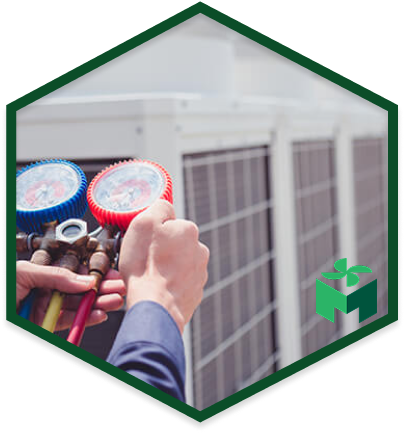
The Maintenance Process: How We execute Commercial Service
Understanding the workflow of a commercial maintenance visit helps facility managers plan their day and minimize disruptions. The goal is to perform a non-invasive, deep clean and inspection that leaves the system running quieter and more efficiently than before.
-
Initial Site Assessment and Safety Check:
The technician arrives on-site and checks in with the facility manager. Before touching the equipment, a safety perimeter is established, and power disconnects are located. The technician performs a visual inspection of the thermostat settings and current zone temperatures to establish a baseline.
-
System Shutdown and Lockout/Tagout:
To safely service the internal components, the system is powered down. For commercial rooftop units or large split systems, lockout/tagout procedures are strictly followed to ensure no accidental power restoration occurs during the service.
-
Component Isolation and Cleaning:
Panels are removed to access internal mechanics. This is when the heavy lifting happens—chemical cleaning of coils, changing of high-efficiency filters, and clearing of drain lines. This step removes the physical barriers to efficiency.
-
Mechanical and Electrical Testing:
Once cleaned, the mechanical parts are tested. The technician measures the amperage draw of the compressor and fan motors. If a motor is drawing amps above its rated load, it indicates imminent failure or high friction.
-
System Restart and Performance Validation:
Power is restored, and the system is allowed to run for a full cycle. The technician monitors the temperature split (the difference between return air and supply air) to verify cooling capacity.
-
Reporting and Recommendations:
The service concludes with a detailed report. This documentation outlines what was done, the current health of the unit, and any recommendations for proactive repairs. This report is vital for your asset management records.
When to Replace vs. Repair Commercial HVAC Units
Deciding between sinking more money into a repair or investing in a new system is a financial calculation that every business owner faces. While Mackey Services prioritizes extending the life of your current equipment, there is a tipping point where repair becomes a liability rather than a solution.
The 50% Rule
A standard metric in the industry is the 50% rule. If the cost of the repair approaches 50% of the value of a new system, replacement is generally the smarter financial move. This is particularly true if the equipment is out of warranty. Spending thousands on a compressor for a 15-year-old unit often results in throwing good money after bad, as other components are likely to fail shortly after.
System Age and Refrigerant Type
Commercial AC units typically last 15 to 20 years, depending on maintenance history and coastal exposure. However, older units utilizing R-22 refrigerant are becoming prohibitively expensive to repair due to the phase-out of this refrigerant. If your system relies on R-22 and develops a leak, the cost of the refrigerant alone may justify a full system replacement with a modern, R-410A or A2L-compliant unit.
Frequency of Breakdowns
If your maintenance log shows repeated service calls for different issues—a capacitor one month, a fan motor the next, a refrigerant leak the following season—the system has become unreliable. In a commercial setting, reliability is paramount. The cost of downtime, lost customers, or unproductive employees often outweighs the monthly cost of financing a new, reliable system.
Energy Efficiency Ratings (SEER/IEER)
Older commercial units often operate at significantly lower efficiency levels compared to modern standards. A unit installed 15 years ago may have a SEER rating of 10 or 12. Modern commercial units can achieve ratings well into the high teens or twenties. Replacing an old “energy hog” can result in utility savings that partially offset the monthly payments for the new equipment.
Local Considerations for HVAC in Coastal Texas
Operating commercial HVAC equipment in this region requires specific attention to environmental factors that are not present in inland areas. The combination of heat, humidity, and salt air creates a unique set of challenges that maintenance must address.
Salt Air Corrosion
For businesses located near the water, salt spray is a relentless enemy. Salt accumulation on aluminum fins and copper tubing causes rapid galvanic corrosion. This leads to “fin rot,” where the aluminum fins disintegrate, leaving the tubing exposed and unable to transfer heat. Routine maintenance in this area must include freshwater rinsing and the application of corrosion-inhibitor coatings to extend the physical life of the metal components.
Extreme Humidity Management
The climate here is characterized by extremely high humidity. Commercial AC units are the primary method of dehumidification for most buildings. If a unit is short-cycling (turning on and off too quickly) due to oversizing or dirty filters, it will cool the air but fail to remove the moisture. This leads to a clammy indoor environment and can promote mold growth in ductwork and on building surfaces. Maintenance checks ensure the system runs long enough cycles to effectively pull moisture from the air.
Drain Line Algae Growth
The combination of warmth, darkness, and constant moisture in the condensate drain pan creates the perfect breeding ground for algae and “slime.” In this region, drain lines clog much faster than in drier climates. Preventative treatment of drain lines is not optional here; it is a necessity to prevent water damage to ceilings and inventory.
Storm Season Preparation
The threat of tropical storms and hurricanes requires commercial units to be securely anchored. During maintenance, technicians check the integrity of hurricane straps and mounting curbs. Ensuring that panels are tightly secured and that the unit structure is sound prevents wind damage and water intrusion during heavy storm events.
Why Specialized Commercial Care Matters
Choosing the right partner for your building’s mechanical systems is about more than just finding someone who can hold a wrench. Commercial systems operate on different principles than residential units, involving three-phase power, economizers, variable frequency drives (VFDs), and complex control strategies.
Minimizing Operational Risk
Your HVAC system is a critical utility. When it fails, revenue stops. Specialized commercial technicians understand the urgency of business continuity. They carry inventory suited for commercial units, reducing the wait time for parts. They also understand the importance of communication, providing clear timelines so you can manage your staff and operations accordingly.
Regulatory and Code Compliance
Commercial buildings are subject to stricter codes regarding ventilation (ASHRAE standards), refrigerant management (EPA Section 608), and energy efficiency. Professional maintenance ensures that your building remains compliant with these regulations, avoiding potential fines and ensuring the safety of your occupants.
Asset Protection and Documentation
For facility managers and business owners, documentation is key. Professional service providers deliver detailed digital service histories. This proof of maintenance is often required to keep manufacturer warranties valid. If a compressor fails five years into a ten-year warranty, the manufacturer will demand proof that the coils were cleaned and the system was maintained. Without this documentation, the warranty claim may be denied.
Long-Term Partnership
A dedicated commercial HVAC partner gets to know your building. They learn the quirks of your specific ductwork, the heat load changes based on your occupancy hours, and the history of previous repairs. This institutional knowledge allows for faster troubleshooting and more accurate recommendations, moving from reactive repairs to proactive asset management.