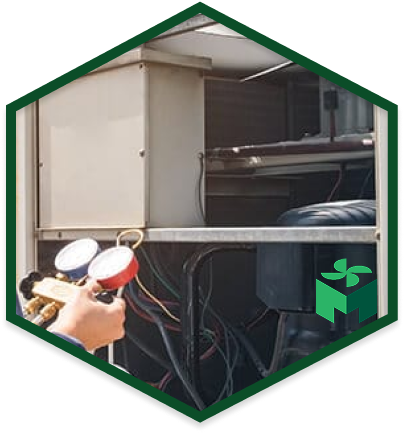
What You Get with Our Commercial Installation Service
Investing in a new commercial AC system is a significant capital expenditure. You need assurance that the hardware installed will perform reliably under extreme stress and provide a return on investment through lower utility costs. The service focuses on delivering systems that are engineered for longevity and ease of maintenance.
- High-Performance Equipment Selection: We select units based on precise load calculations, not just “rule of thumb” estimates. This ensures the system is neither undersized (running constantly without cooling effectively) nor oversized (short-cycling and failing to dehumidify). We work with Rooftop Units (RTUs), Split Systems, and Variable Refrigerant Flow (VRF) systems suited for diverse commercial footprints.
- Advanced Dehumidification Capabilities: Standard cooling often fails to address the moisture content in the air near the Gulf Coast. Our installations prioritize units with high latent cooling capacities. This creates a crisp, comfortable environment even when outdoor humidity levels are near saturation points, preventing that clammy feeling common in poorly conditioned buildings.
- Energy Efficiency and ROI: Newer systems come with higher SEER (Seasonal Energy Efficiency Ratio) and EER (Energy Efficiency Ratio) ratings. Moving from an older 10 SEER unit to a modern high-efficiency model can drastically reduce monthly operational costs. We focus on installing equipment that meets or exceeds current energy standards, positioning your business to benefit from lower overheads for the lifespan of the unit.
- Smart Control Integration: Modern installations include the integration of building automation systems or smart thermostats. This allows facility managers to monitor usage, set schedules, and control multiple zones remotely. This granular control prevents energy waste during non-operational hours and alerts you to potential maintenance issues before they become critical failures.
Installation Process Simplified
A commercial installation is a complex logistical operation that requires precise coordination to minimize disruption to your daily activities. We adhere to a strict protocol to ensure safety, speed, and accuracy during the transition from your old system to the new one.
- Site Assessment and Load Calculation: First, technicians conduct a comprehensive walkthrough of the facility. This involves measuring square footage, assessing insulation levels, window placement, and internal heat loads from machinery or occupancy. A Manual N load calculation is performed to determine the exact cooling requirements for the space.
- System Design and Selection: We propose a system design that addresses the specific findings of the assessment. This includes selecting the appropriate tonnage and unit type. At this stage, we also verify that existing ductwork is sufficient for the airflow requirements of the new system or identify areas that need modification.
- Safe Removal and Disposal: Prior to installation, the old equipment must be safely decommissioned. This involves recovering existing refrigerant according to EPA guidelines to prevent environmental contamination. Heavy machinery, such as cranes, is coordinated to lift old rooftop units off the building safely, ensuring no damage to the roof structure.
- Professional Installation: The new units are lifted into place and secured. Technicians connect the refrigerant lines, electrical wiring, and condensate drains. Great care is taken to braze lines with nitrogen to prevent oxidation and ensure a clean refrigeration circuit. All ductwork connections are sealed to prevent air leakage.
- Testing and Commissioning: Finally, the system is started up and rigorously tested. We check airflow, static pressure, refrigerant charge, and amperage draw. The system is balanced to ensure even cooling across all zones. We do not consider the job complete until the unit is performing within manufacturer specifications and the indoor temperature is stabilizing.
Deciding Between Repair or Complete Replacement
One of the most difficult decisions a facility manager faces is whether to authorize another repair on an aging unit or to approve a full replacement. While repairs offer a lower immediate cost, they can often lead to higher long-term expenses if the unit is near the end of its service life.
- The 50% Rule: If the cost of the repair approaches 50% of the value of the system or the cost of a new unit, replacement is generally the smarter financial move. Pouring money into a compressor replacement for a 15-year-old unit is rarely cost-effective.
- Frequency of Breakdowns: If your system requires service calls multiple times a year, it is signaling the end of its reliability. Frequent downtime disrupts business and the cumulative cost of service calls often exceeds the monthly financing payments for a new system.
- Age of the Equipment: Commercial AC units generally have a lifespan of 15 to 20 years. In the harsh heat of Pearland and surrounding areas, this lifespan can be shorter due to the intense workload placed on the system. If your unit is over 15 years old, efficiency has likely degraded significantly, and parts may be becoming obsolete.
- Refrigerant Type: Older systems often utilize R-22 refrigerant, which has been phased out due to environmental regulations. As supplies of R-22 dwindle, the cost to recharge these systems has skyrocketed. Upgrading to a system that uses R-410A or newer refrigerants future-proofs your asset and lowers maintenance costs.
- Energy Bills: A sudden or gradual spike in energy costs without a change in usage patterns indicates the system is losing efficiency. New systems can lower cooling energy consumption by 20-40%, providing savings that help offset the installation cost over time.
Local Compliance and Benefits
Operating in Texas requires strict adherence to specific building codes and energy regulations. Ignoring these can lead to fines, failed inspections, or difficulties in selling the property later.
- Texas Energy Code Compliance: The state enforces the International Energy Conservation Code (IECC) with state-specific amendments. This mandates minimum efficiency standards for commercial HVAC equipment. Mackey Services ensures that every unit installed meets or exceeds these statutory requirements, keeping your building code-compliant.
- Permitting and Inspections: Commercial installations typically require permits from local municipal authorities. This ensures that the electrical and mechanical work meets safety standards. We handle the logistical burden of pulling necessary permits and scheduling required inspections, ensuring that the project proceeds without legal hurdles.
- Rebate Programs: Many utility providers in the Texas market offer rebates for businesses that upgrade to high-efficiency HVAC equipment. These incentives are designed to reduce the load on the electrical grid — check our specials for additional savings. We assist in identifying eligible equipment and providing the necessary documentation to help you claim these financial incentives.
- Seasonal Considerations: The ideal time to replace a commercial unit is during the shoulder seasons (spring or fall), but failure often happens during peak summer. We are equipped to handle installations year-round, utilizing protocols to keep your business cool even during the installation process whenever possible.
Proof of Excellence in Commercial HVAC
When selecting a contractor for commercial AC installation, technical expertise and verified capabilities are paramount — read our reviews to verify. The complexity of commercial systems requires a higher level of training than residential work.
- Licensed and Insured: We hold all necessary state licenses to perform commercial HVAC work in Texas. Furthermore, we carry comprehensive liability insurance and workers’ compensation coverage. This protects your business from liability in the event of an accident during the installation process.
- Specialized Commercial Training: Our technicians undergo specific training for commercial systems, including three-phase electrical systems, variable frequency drives, and complex control loops. This expertise ensures that the installation is done correctly the first time, preventing premature failures caused by installation errors.
- Focus on Safety: Commercial installations often involve working at heights, handling heavy loads, and working with high-voltage electricity. We adhere to strict OSHA safety standards to protect our crew and your property.
- Project Management: We assign a dedicated project lead to commercial installations. This provides you with a single point of contact for updates, scheduling, and questions. Clear communication ensures that the project stays on timeline and within budget.
Your business deserves a cooling system that works as hard as you do. Don’t let an inefficient or broken AC unit compromise your operations or comfort. Secure a reliable, energy-efficient future for your commercial space today.