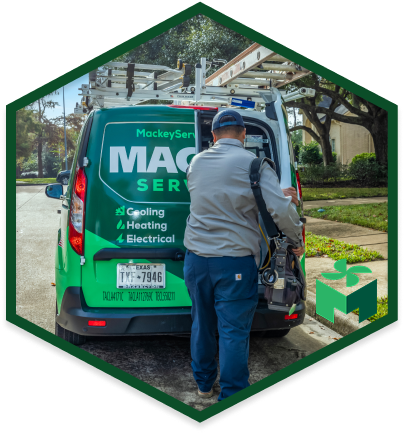
Today’s Services: Fast, Effective, and Fully Detailed
When you book a maintenance appointment, you are paying for a comprehensive restoration of your system’s efficiency. Mackey Services does not believe in superficial “tune-ups” that only address cosmetic issues. Our technicians arrive fully equipped to perform a detailed audit and cleaning of your air conditioning unit. We follow a strict checklist designed to improve the longevity of your asset and ensure it operates according to the manufacturer’s specifications.
Here is what you can expect from our maintenance visit:
- Condenser and Evaporator Coil Cleaning: Over time, dirt, dust, and debris build up on your coils. This layer acts as insulation, preventing the coils from effectively releasing or absorbing heat. We chemically clean these coils to ensure maximum heat transfer, which allows the system to cool your home faster using less energy.
- Refrigerant Level Inspection: Incorrect refrigerant levels, whether too high or too low, can drastically reduce efficiency and damage the compressor. We measure superheat and subcooling temperatures to ensure the refrigerant charge is exact, ensuring optimal cooling capacity.
- Condensate Drain Clearing: A clogged drain line can cause water damage to your ceiling or floors and trigger the system to shut down. We clear the condensate drain and trap to prevent algae buildup and ensure proper moisture removal, which is critical for humidity control in our region.
- Electrical Component Tightening: Vibration from the system can loosen electrical connections over time. Loose connections can cause dangerous arcing and damage components. We inspect and tighten all connections and measure voltage and amperage on motors to catch potential failures before they happen.
- Thermostat Calibration: If your thermostat is reading the temperature incorrectly, your AC runs longer than necessary. We verify the calibration of your thermostat to ensure it communicates accurately with your HVAC system.
- Moving Parts Lubrication: Friction causes heat and wear. We apply lubricant to motors and bearings where applicable to reduce friction, allowing parts to move freely and requiring less electricity to operate.
- Blower Motor Inspection: The blower is responsible for circulating air throughout your home. We inspect the wheel for dust buildup, which can unbalance the fan and reduce airflow, and clean it to restore proper circulation.
How We Restore Your Comfort: Our Proven AC Maintenance Process
We have refined our maintenance process to be thorough, transparent, and respectful of your time and property. We understand that inviting a technician into your home requires trust, and we honor that by adhering to a structured workflow that guarantees consistent results.
- System Assessment and Startup: The technician begins by operating the system to establish a baseline of current performance. We listen for abnormal sounds, check for vibrations, and observe the startup cycle to identify immediate red flags.
- Power Down and Safety Check: Before touching internal components, we disconnect power to the unit to ensure safety. We then inspect the safety controls of the unit to ensure that, in the event of a surge or mechanical failure, the system will shut down properly to prevent fire or further damage.
- Deep Clean and Adjust: This is the core of the service. We remove panels to access the internal mechanics. We clear debris from the outdoor unit, clean the coils, and perform the electrical and mechanical adjustments detailed in our service scope. This step addresses the accumulated wear and tear from previous seasons.
- Re-Commissioning and Testing: Once the physical work is done, we power the system back up. We monitor the system for a full cycle, measuring the temperature split (the difference in temperature between the supply and return air) to verify that the cooling capacity has improved.
- Performance Report: Finally, we provide you with a detailed report of what was done. If we discover a component that is nearing the end of its life—such as a weak capacitor or a pitted contactor—we inform you immediately with a clear explanation of why it matters, allowing you to make a decision about proactive replacement without pressure.
Deciding Between AC Repair and Replacement: What You Need to Know
One of the most difficult decisions a homeowner faces is whether to continue repairing an aging unit or to invest in a new system. This decision should be based on data and financial logic, not just the age of the unit. We help you navigate this choice by evaluating the condition of your current system against modern efficiency standards.
- The 50% Rule: A general guideline is that if the cost of the repair equals or exceeds 50% of the value of a new system, replacement is the smarter financial move. Continuing to dump money into a depreciating asset that will likely break again soon is rarely cost-effective.
- Refrigerant Type: If your system utilizes R-22 (Freon), which has been phased out due to environmental regulations, repair costs involving refrigerant will be astronomical. In this case, upgrading to a system that uses R-410A or newer refrigerants is almost always the correct path.
- Frequency of Breakdowns: If you are calling for repairs more than once a season, the reliability of the unit is gone. The cumulative cost of service calls, parts, and the inconvenience of downtime often outweighs the monthly cost of financing a new, reliable unit.
- Energy Efficiency (SEER Ratings): Older units likely have a SEER rating of 10 or 12. Modern units start around SEER 14 and go much higher. Replacing a 15-year-old unit with a high-efficiency model can reduce your cooling costs by 20% to 40%, effectively helping the new unit pay for itself over time.
- Comfort Issues: If your current system struggles to dehumidify your home or leaves hot and cold spots in different rooms, a repair will not fix the underlying design or capacity issue. A replacement allows you to resize the system and address ductwork issues for superior comfort.
Local Insights: Pearland Weather and AC Care
Operating an air conditioner in this specific region presents unique challenges that generic maintenance guides often overlook. The climate here is characterized by intense heat combined with suffocating humidity. This environment creates a specific set of stressors for HVAC equipment that requires localized expertise to manage.
- The Humidity Factor: From June to September, humidity levels are consistently high. Your air conditioner is your primary dehumidifier. If the coils are dirty or the refrigerant is low, the system runs but fails to pull moisture out of the air. This leads to a cold but “clammy” feeling indoors and promotes mold growth in ductwork. Our maintenance focuses heavily on condensate drainage and coil cleanliness to combat this.
- Extended Run Times: Because mild temperatures are rare in the summer, systems here run for longer cycles than in cooler climates. This equates to higher “mileage” on the compressor and motors. A 10-year-old system here has done the work of a 20-year-old system in the Northeast. This makes lubrication and electrical checks vital to prevent burnout.
- Permitting and Regulations: When maintenance turns into major repair or replacement, local codes come into play. Specific permits are often required for significant HVAC work to ensure safety and compliance with energy codes. We handle all regulatory aspects, ensuring that any work performed on your property meets local municipal standards.
- Utility Rebates: Local utility providers often incentivize energy efficiency — view current specials. Regular maintenance helps you qualify for these programs by keeping your system running at the efficiency levels required for rebates. Furthermore, upgrading to higher-efficiency units often triggers substantial rebates from companies serving the area, which we can help you navigate.