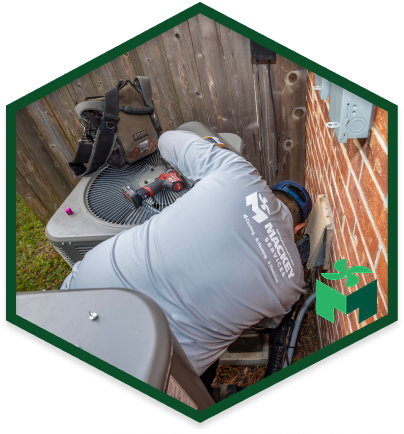
Your Step-by-Step Guide to AC Installation
A professional installation follows a rigorous protocol to ensure safety, efficiency, and longevity. We adhere to a strict process that protects your property while ensuring the new equipment is installed to factory specifications. This systematic approach eliminates guesswork and reduces the risk of premature system failure.
- Site Preparation and Safety: The process begins with preparing the workspace. Technicians lay down drop cloths and floor protectors to prevent damage to your home. Power to the existing HVAC system is disconnected at the main breaker panel to ensure electrical safety during the extraction process. The area around the outdoor condenser is cleared of debris or vegetation to provide a clean working surface.
- Refrigerant Recovery and Removal: Before the old unit can be moved, the existing refrigerant must be recovered according to EPA regulations. Venting refrigerant into the atmosphere is illegal and harmful. We use specialized recovery machines to capture the old coolant. Once the system is empty, the old condenser and indoor evaporator coil are disconnected and removed from the property for proper disposal.
- Positioning the New Equipment: The new outdoor condenser requires a stable, level surface. We inspect the existing pad and replace it if it is cracked or unlevel. A level pad is critical for the proper operation of the compressor and helps reduce vibration and noise. Inside, the evaporator coil is carefully positioned within the air handler or furnace, ensuring a tight seal to prevent air leakage.
- Line Set Connection and Brazing: The copper refrigerant lines (the line set) connecting the indoor and outdoor units are inspected or replaced. Technicians braze the connections using nitrogen purging. Flowing nitrogen through the lines during brazing prevents oxidation and scale buildup inside the copper, which can otherwise clog the sensitive valves of modern high-efficiency systems.
- Vacuum and Charging: Once the physical connections are made, a vacuum pump is attached to the system. This step removes moisture and non-condensables from the lines. Moisture inside the system is fatal to the compressor and causes acid buildup. After achieving a deep vacuum, the system is charged with the precise amount of new refrigerant specified by the manufacturer.
- Electrical and Drainage Setup: High-voltage wiring is connected to the disconnect box, and low-voltage control wiring is connected to the thermostat. A new condensate drain line is installed, often with a safety float switch. This switch automatically shuts off the unit if the drain backs up, preventing water damage to your ceilings or floors.
- Final Testing and Commissioning: The system is powered on and tested. Technicians measure static pressure, airflow, and temperature splits (the difference in temperature between supply and return air) to verify the system is cooling effectively. We do not leave until the system is performing strictly within the manufacturer’s design parameters.
Deciding Between AC Repair or Replacement: What You Need to Know
Determining whether to repair an aging unit or invest in a new installation is a financial and logical decision. While repairs can solve immediate issues, there is a tipping point where pouring money into an old system becomes less economical than replacement. This decision usually hinges on the age of the unit, the cost of the repair, and the type of refrigerant the system uses.
Age is the primary factor. Most air conditioners in Texas have a lifespan of 10 to 15 years due to the heavy workload required by the climate. If your unit is over 10 years old and requires a major repair, such as a compressor replacement, the investment is rarely worth it. Modern systems are significantly more efficient, meaning a new unit begins paying for itself immediately through lower electricity bills.
The “50% Rule” is a helpful metric. If the cost of the repair approaches 50% of the value of a new system, replacement is the smarter choice. Additionally, consider the frequency of breakdowns. If Mackey Services has visited your home multiple times in the last two years for different issues, the system is likely entering a phase of terminal failure. Continuing to patch it is simply delaying the inevitable while enduring inconsistent comfort.
Refrigerant type is another critical consideration. Older units utilizing R-22 (Freon) are becoming obsolete. R-22 is no longer manufactured, making it essentially unavailable or prohibitively expensive to acquire. If your older system develops a refrigerant leak, a simple recharge is often not a viable option financially. Upgrading to a system that uses R-410A or newer refrigerants ensures you are compliant with current standards and can easily service the unit in the future — view our specials today.
- Energy Bills: A sudden spike in energy costs often indicates the system is losing efficiency and working overtime to maintain temperature.
- Uneven Cooling: If some rooms are freezing while others are hot, the system may have lost compression or airflow capacity.
- Excessive Noise: Grinding, squealing, or banging noises usually signal severe mechanical distress within the motor or compressor.
- Humidity Issues: An aging unit loses its ability to effectively remove moisture, leading to a sticky, uncomfortable indoor feel even when the thermostat reads a cool temperature.
Tailored to Texas: Installation Permits and Seasonal Considerations
Installing an air conditioner in the Pearland area involves more than just technical expertise; it requires adherence to local municipal codes and an understanding of the regional climate. Compliance is not optional. Operating without permits can lead to fines, issues with home insurance claims, and complications when selling your home in the future.
We handle the permitting process entirely. This includes verifying that the electrical circuit is rated for the new unit’s amperage and that the installation meets all setback requirements from property lines. In many Texas jurisdictions, there are strict requirements regarding energy efficiency ratings (SEER2) that must be met for new installations. We ensure that every unit we install meets or exceeds these federal and local energy mandates.
Seasonality plays a massive role in the timing and urgency of installation. In this region, summer temperatures frequently soar above 90°F with crushing humidity. Waiting until your unit completely dies in July puts you in a difficult position, as demand for HVAC services peaks simultaneously. Scheduling a replacement during the milder spring or autumn months—often referred to as the “shoulder seasons”—can sometimes result in more flexible scheduling and faster turnaround times.
Humidity control is a specific necessity for Texas homeowners. Standard AC units cool the air, but in our climate, we often recommend two-stage or variable-speed compressors. These units run for longer periods at lower speeds, which allows for greater moisture removal without over-cooling the space. This results in a home that feels cooler at a higher thermostat setting, saving energy while maximizing comfort.
Why Choose Professional Installation for Your Home
Selecting the right contractor is just as important as selecting the right equipment. The longevity of your air conditioner is dictated 70% by the quality of the installation and 30% by the manufacturing quality. A top-tier brand installed poorly will fail sooner and run less efficiently than a mid-tier brand installed perfectly.
We employ NATE-certified technicians who undergo continuous training to stay updated on the latest HVAC technologies and code requirements. This technical proficiency ensures that every braze is sealed, every wire is torqued to spec, and every duct connection is airtight. We do not use subcontractors; every technician entering your home is vetted, insured, and trained to respect your property.
Furthermore, we believe in transparency regarding the scope of work. You will receive a clear explanation of the installation plan, the equipment being used, and the timeline for completion. There are no hidden fees for “unexpected” parts that should have been included in the original assessment. Our goal is to provide a turnkey solution that restores your home’s comfort with zero friction.