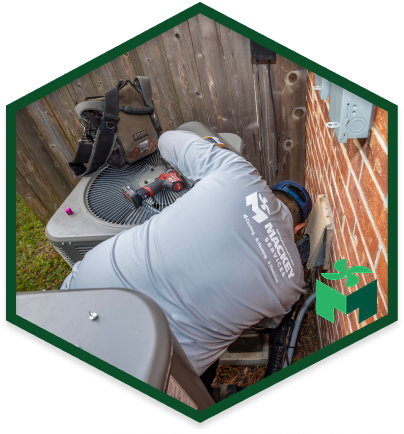
Step-by-Step Guide to Your New AC Installation
Understanding the installation timeline helps you prepare your home and schedule your day. A standard replacement typically takes between four to eight hours, depending on the complexity of the project and access to the installation site. The crew arrives with all necessary equipment, aiming to complete the job with minimal disruption to your household.
The process is methodical, adhering to manufacturer specifications and safety protocols. Shortcuts during installation are the leading cause of early system failure, so every connection and setting is double-checked.
- Arrival and Site Protection: The team arrives on time and lays down drop cloths and floor protectors to ensure your home remains clean throughout the process.
- Safety Disconnect: Power is cut to the HVAC circuits to ensure safety. The refrigerant from the old unit is recovered into a specialized tank to meet EPA regulations, rather than being vented into the atmosphere.
- Removal of Old Equipment: The outdoor condenser and the indoor evaporator coil (and furnace/air handler if a full system replacement is occurring) are disconnected and removed.
- Positioning the New Units: The new indoor coil and air handler are set in place, ensuring a tight seal with the supply and return plenums. The outdoor condenser is positioned on a composite pad to dampen vibration and keep it off the ground.
- Line Set Connection: The copper refrigerant lines specifically sized for the new unit are connected. If the old lines are being reused, they are flushed thoroughly to remove contaminants. In many cases, new lines are run to ensure compatibility with modern refrigerants.
- Brazing and Sealing: Technicians braze the copper connections using nitrogen to prevent oxidation inside the pipes. This is a critical step that prevents blockages in the expansion valve later on.
- Electrical and Control Wiring: High-voltage electrical lines are connected to the disconnect box and the unit. Low-voltage thermostat wires are connected to the control board to ensure the thermostat can accurately cycle the system.
- Vacuum and Charge: A deep vacuum is pulled on the lines to remove all moisture and air. Once the vacuum holds, the factory-specified amount of refrigerant is released into the system.
- Commissioning and Testing: The system is powered on. Technicians measure static pressure, airflow, and temperature splits (the difference in temperature between the air going in and the air coming out) to verify the unit is performing exactly as rated.
Deciding Between AC Repair vs. Replacement: What You Need to Know
Homeowners often struggle with the decision to repair an aging unit or invest in a new one. While a repair might seem cheaper upfront, it can be a temporary patch on a failing system that will cost more in the long run. There are clear technical and financial indicators that signal when a replacement is the smarter financial move.
The “50% Rule” is a common industry standard used to aid this decision. If the cost of the repair approaches 50% of the value of a new system, replacement is generally the better option. Additionally, if the unit requires frequent repairs, those costs accumulate quickly, often exceeding the price of a monthly payment on a new, warranted system.
- Age of the Equipment: Air conditioners in Texas generally last 10 to 15 years due to the heavy workload. If your unit is over 10 years old and facing a major component failure (like a compressor or blower motor), replacement is recommended.
- Rising Energy Bills: As components wear out and coils get dirty or corroded, the system works harder to provide the same amount of cooling. If you notice a steady increase in electricity costs despite normal usage, the unit has likely lost its efficiency.
- Refrigerant Type: Older units utilize R-22 (Freon), which has been phased out and is incredibly expensive to source. If an older unit leaks R-22, the cost to recharge it often makes repair illogical compared to upgrading to a system using R-410A or newer eco-friendly refrigerants.
- Inconsistent Comfort: If some rooms are freezing while others are hot, or if the unit struggles to maintain the set temperature during the heat of the day, the compressor is likely losing compression or the unit is undersized.
- Noise and Odors: Excessive grinding, squealing, or rattling noises indicate internal mechanical failure. Strange smells can indicate burnt wiring or mold growth inside the unit that cleaning cannot fully resolve.
Navigating Local Regulations and Efficiency Standards
Installing an air conditioner in Dickinson involves adherence to specific local building codes and state regulations. These rules are in place to ensure safety, energy efficiency, and grid reliability. Professional installers handle the permitting process entirely, ensuring that the homeowner is not liable for unpermitted work which can cause issues during a future home sale.
Texas has adopted strict efficiency standards. The Department of Energy (DOE) enforcement of SEER2 (Seasonal Energy Efficiency Ratio) minimums means that any new unit installed must meet higher efficiency benchmarks than in previous years. This is beneficial for homeowners, as it guarantees lower operational costs, but it requires precise equipment matching.
- Permitting Requirements: Most municipalities require a mechanical permit for AC replacement. This triggers a third-party inspection upon completion to verify that the electrical connections are safe, the gas lines (if applicable) are up to code, and the condensate drain is routed correctly.
- Condensate Management: In humid climates, AC units produce gallons of water daily. Codes require a primary drain line and a secondary safety system (like a secondary drain pan with a float switch) to prevent water damage to ceilings and floors if the main line clogs.
- Electrical Upgrades: Modern units may have different amperage requirements than older models. Installers verify that the existing circuit breaker and wire gauge are sufficient to handle the new load without overheating.
- Rebate Eligibility: Many high-efficiency units qualify for rebates from local utility providers or federal tax credits. Documentation of the installation and the ARI certificate (which proves the efficiency rating) is provided to help you claim these savings.
Why Choose Us? Trusted by Homeowners Across the Region
Selecting a contractor is just as important as selecting the brand of the air conditioner. A top-tier unit installed poorly will fail prematurely and consume excessive energy. Mackey Services has built a reputation on technical excellence and transparent communication. The focus is not just on the sale, but on the lifecycle of the system.
Homeowners in the area choose this service because the technicians are trained to look at the house as a system. They do not guess on sizing or cut corners on materials. Every copper joint, electrical connection, and duct seal is executed with professional pride.
- Technical Certification: Technicians undergo continuous training to stay updated on the latest HVAC technology, inverter-driven compressors, and smart thermostat integration.
- Transparent Pricing: You receive a detailed quote before work begins. There are no hidden fees for “unexpected” parts that should have been included in the original assessment.
- Respect for Your Home: The installation crew treats your property with care, using shoe covers and cleaning up the workspace completely before leaving.
- Post-Installation Support: The relationship does not end when the truck drives away. The team handles warranty registration and provides clear instructions on how to operate and maintain the new system.
- Quality Control: A senior technician or field supervisor reviews the installation parameters to ensure the system is operating within the manufacturer’s specified range for superheat and subcooling.