
Understanding Your Mobile Home’s Electrical Needs
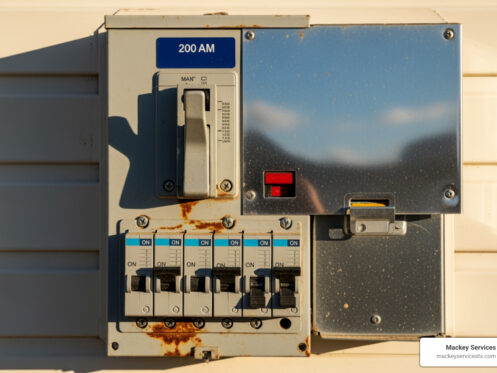
A 200 amp breaker box for mobile home installations is a specialized electrical panel designed to handle the power demands of modern living while meeting the unique requirements of manufactured housing. Unlike standard residential panels, mobile home breaker boxes must be outdoor-rated, weatherproof, and compliant with specific National Electrical Code requirements. If you’re considering an upgrade, understanding these differences is essential for making the right choice for your home’s safety and performance.
Key Options for Mobile Home 200 Amp Breaker Boxes:
- Outdoor-rated main breaker panels – NEMA 3R enclosures with weatherproof protection
- Pedestal-mount units – Designed specifically for mobile home installation standards
- Meter combination panels – Integrate metering and distribution in one unit
- 8-space/16-circuit to 40-space/80-circuit configurations – Various capacity options for different needs
- Plug-on neutral technology – Simplified wiring for modern AFCI/GFCI breakers
Whether you’re upgrading from an older 100-amp service or replacing a failing panel, choosing the right 200-amp breaker box requires understanding mobile home-specific requirements, safety codes, and your household’s power needs. For homeowners in the Greater Houston area facing extreme weather and high electrical demands, a properly sized and installed panel is critical for both safety and reliability.
If you’re planning a comprehensive residential electric panel upgrade, professional installation ensures compliance with local codes. Contact Mackey Services for expert electrical panel services in the Houston area.
Why Upgrade Your Mobile Home to a 200-Amp Service?
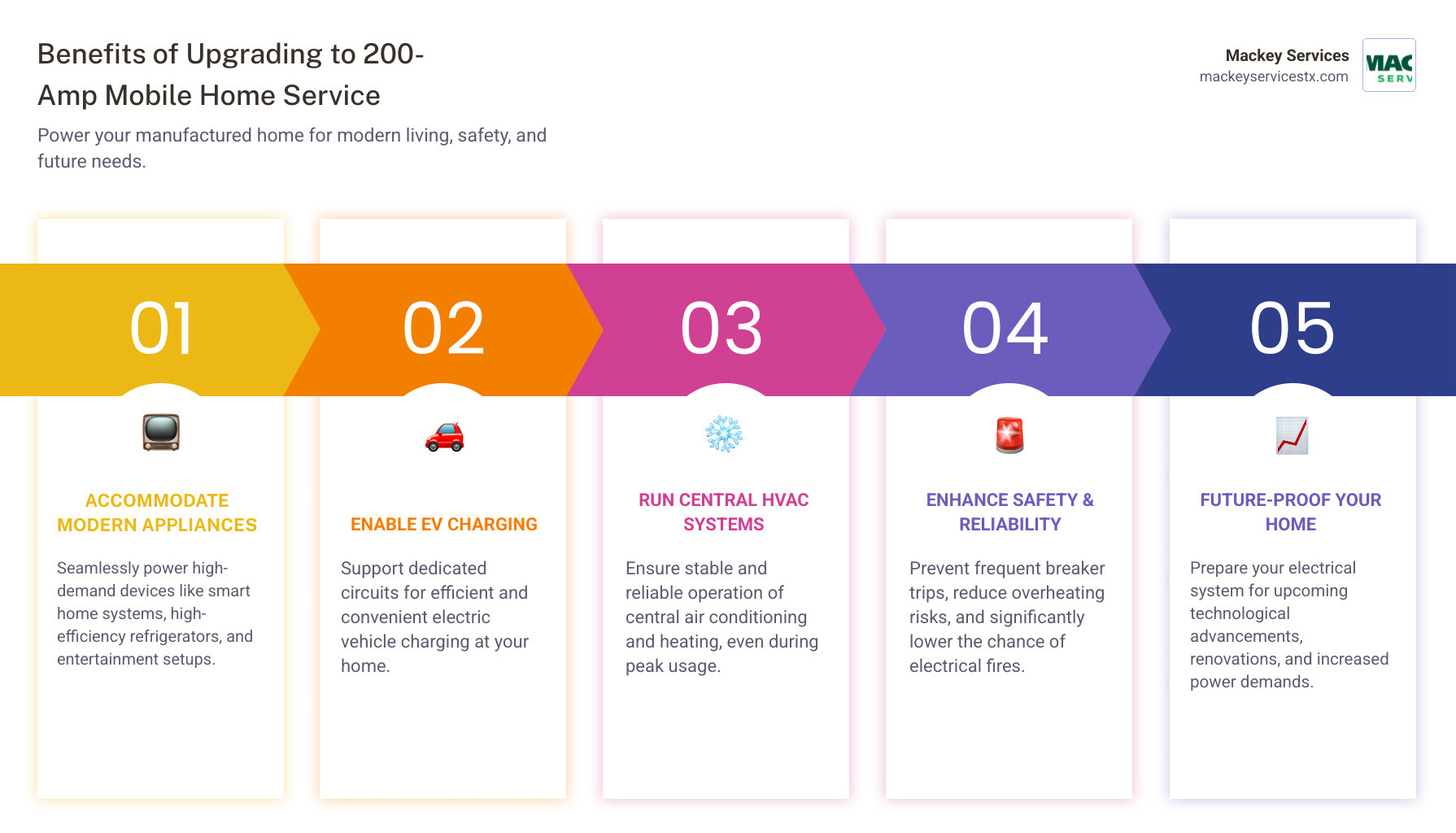
The electrical demands of our homes have grown exponentially over the years. What was once sufficient for a simpler mobile home life might now be struggling to keep up with our modern gadgets and conveniences. Upgrading to a 200-amp service for your mobile home isn’t just about getting more power; it’s about enhancing safety, efficiency, and preparing your home for the future.
We often see older mobile homes in areas like League City, Friendswood, and Pearland with 100-amp or even 60-amp electrical services. While these might have been adequate decades ago, they simply can’t handle the power requirements of today’s appliances and technology. Modern mobile homes, much like traditional stick-built homes, rely on a multitude of electrical devices. From high-efficiency refrigerators and dedicated laundry circuits to advanced entertainment systems and powerful kitchen appliances, our homes are consuming more electricity than ever before.
Consider the surge in demand from modern necessities like central HVAC systems, which are crucial for comfort in the Texas heat. These systems draw significant power, and an undersized electrical panel can lead to frequent tripped breakers and potential damage to your unit. Furthermore, the rise of electric vehicles means more homeowners are looking for in-home charging solutions. An EV charging station, like those we install in Alvin or Dickinson, requires a substantial dedicated circuit, often 40 to 60 amps on its own. Without a robust 200-amp service, accommodating such an addition would be nearly impossible or unsafe. If you’re wondering how many amps do I need in my house, a 200-amp service is typically the standard for modern homes.
Beyond convenience, safety is paramount. An electrical system that is constantly overloaded is a fire hazard. Older panels might not have the capacity to safely distribute power to all your devices, leading to overheating wires, damaged insulation, and a heightened risk of electrical fires. A 200-amp breaker box provides ample capacity, ensuring that circuits are not overburdened and that the overcurrent protection (the breakers themselves) can effectively do their job, tripping when necessary to prevent dangerous situations. This significantly reduces the risk of electrical fires and ensures the safety of your family and your property.
Finally, upgrading to a 200-amp service is a smart investment in future-proofing your mobile home. As technology continues to evolve, so too will our electrical needs. A 200-amp panel offers the flexibility to add new appliances, expand your smart home capabilities, or even install a backup generator without immediately requiring another costly electrical upgrade. It also makes your home more appealing to potential buyers down the line, as a modern, safe electrical system is a significant selling point.
Mobile Home vs. Standard Breaker Boxes: Key Differences
While the core function of any electrical panel is to safely distribute electricity throughout a property, mobile home breaker boxes have distinct characteristics that set them apart from those found in traditional site-built homes. These differences are crucial for ensuring safety and compliance with specific regulations governing manufactured housing.
One of the most significant distinctions is the outdoor rating. Mobile home electrical panels are almost exclusively designed for outdoor installation. This means they must be housed in a robust, weatherproof enclosure, typically with a NEMA 3R rating. This rating signifies that the enclosure provides protection against falling dirt, rain, sleet, and external ice formation, which is vital for panels exposed to the elements in places like Galveston or Texas City. Standard residential panels, on the other hand, are often designed for indoor use, housed in basements, garages, or utility closets where they are protected from weather.
The need for an outdoor panel also often leads to pedestal mounting. Many mobile home parks or individual mobile home setups use a separate pedestal unit that houses the meter, the main disconnect, and the breaker panel. This pedestal is anchored securely into the ground, providing a centralized and accessible point for utility connections. Some panels are also designed for surface mounting directly on the exterior wall of the mobile home, but they still require the same NEMA 3R weather protection.
Another common feature is the meter combination unit. It’s very typical for mobile home panels to integrate the electrical meter and the main breaker panel into a single, compact outdoor unit. This simplifies the service entrance connection and provides a convenient point for utility companies to read usage and for homeowners to access the main disconnect.
Mobile homes also have specific service disconnect requirements. The main disconnect for a mobile home’s electrical system must be located outdoors and readily accessible. This is a critical safety feature, allowing emergency personnel or utility workers to quickly cut power to the entire home if needed. This outdoor disconnect is usually part of the meter combo unit or a separate outdoor shutoff breaker. The main breaker within the mobile home’s 200-amp panel itself often functions as a sub-panel’s main breaker in relation to the outdoor service disconnect. Understanding what’s the difference between an electrical panel and a circuit breaker is key here, as the panel houses multiple circuit breakers, while the main breaker acts as the primary safety device for the entire panel.
Finally, while grounding and bonding rules are fundamental to all electrical installations, mobile homes may have specific nuances related to their chassis and the way they are connected to the main service ground. These are all considerations that our experienced electricians in places like Dickinson and Friendswood are well-versed in.
Key Features of a 200 Amp Breaker Box for a Mobile Home
Choosing the right 200 amp breaker box for a mobile home requires a keen eye for specific features that ensure safety, compliance, and optimal performance for years to come. Let’s dig into what makes a great mobile home electrical panel.
At the heart of any 200-amp mobile home panel is the main breaker. This is the primary overcurrent protection device that controls all power flowing into your home. It’s crucial that this main breaker is properly sized to match your service entrance capacity. For mobile homes, this is almost always an outdoor-rated unit. The panel will also contain multiple smaller circuit breakers, each protecting individual circuits for lighting, outlets, and appliances.
The circuit capacity of the panel is another vital consideration. This refers to the number of individual circuits the panel can accommodate. Modern mobile homes, especially all-electric ones common in the Greater Houston area, need plenty of circuits. Think about your electric water heater, dryer, stove, and your HVAC system, all demanding dedicated circuits. The panel’s internal design, particularly the bus bar material, is also important. Copper bus bars are highly recommended for their excellent conductivity and durability, ensuring efficient power distribution throughout your home.
Always look for a panel that carries a UL Listing. This certification from Underwriters Laboratories signifies that the product has been tested to rigorous safety standards. It’s a non-negotiable mark of quality and safety for any electrical component, especially one as critical as your main breaker box.
Sizing and Capacity: Spaces & Circuits
When we talk about panel capacity, we often refer to “spaces” and “circuits.” A “space” is a physical slot in the panel where a breaker can be installed. A “circuit” refers to the actual electrical path protected by a breaker. Some panels allow for “tandem” or “half-size” breakers, meaning one space can accommodate two circuits. However, with the increasing requirements for AFCI (Arc Fault Circuit Interrupter) and GFCI (Ground Fault Circuit Interrupter) breakers, which typically take up a full space, it’s wiser to choose a panel with ample physical spaces.
Planning for future needs is essential. We recommend opting for a panel with more spaces than you currently think you’ll need. This provides flexibility for adding new appliances, expanding living spaces, or installing new technologies like EV chargers or smart home systems down the road. For an all-electric mobile home, a 30-space/60-circuit or even a 40-space/80-circuit panel is often a good idea. This prevents the headache and expense of needing to upgrade again sooner than expected. Overloading an existing, undersized panel is a common issue we see in older homes, and it’s a primary reason how to know when to upgrade your homes electric panel.
Enclosure Types and Ratings
As we’ve discussed, mobile home breaker boxes are predominantly outdoor panels. This necessitates a robust enclosure designed to withstand the elements. Look for panels with a NEMA 3R rating, which means they are built to protect the internal electrical components from rain, sleet, and external ice formation, as well as falling dirt. This rating is critical for the harsh weather conditions we sometimes experience in areas like Galveston, League City, and Pearland.
These outdoor panels come in various mounting configurations, including pedestal mount and surface mount. Pedestal-mounted units are freestanding and often integrate the utility meter, providing a central service point. Surface-mounted units attach directly to the exterior of the mobile home. Regardless of the mounting type, the enclosure material should offer excellent corrosion resistance. Many high-quality mobile home panels feature a Type-G90, hot-dipped galvanized carbon steel construction for superior protection against rust and environmental wear. This durability is key for 10 outdoor electrical safety tips and the longevity of your electrical system.
Choosing the Right 200 amp breaker box for a mobile home
Beyond basic capacity and outdoor rating, several other features can make a significant difference in the quality and ease of installation and maintenance of your 200 amp breaker box for mobile home.
One important distinction is between main breaker and main lug panels. A main breaker panel includes the primary disconnect breaker for the entire panel, offering convenient protection. A main lug panel, on the other hand, only has lugs (terminals) for the main incoming wires and relies on an upstream main breaker (often at the meter or a separate disconnect) for overall protection. For mobile homes, a main breaker panel is typically preferred or required at the point of service entrance.
Some mobile home panels also feature feed-thru lugs. These are additional terminals that allow power to be “fed through” the panel to supply another downstream panel or structure, such as a detached garage or shed. This can be a very convenient feature for expanding your property’s electrical infrastructure.
Modern panels increasingly feature a plug-on neutral design. This innovative feature simplifies wiring for AFCI and GFCI breakers by allowing the neutral wire to simply “plug on” to a bus bar, eliminating the need for pigtails. This makes installation faster and cleaner, which is a big plus for our electricians. This compatibility with modern breakers, particularly AFCI and GFCI types, is crucial for improved safety. These advanced breakers detect hazardous conditions like arc faults and ground faults, quickly cutting power to prevent fires and electric shock. Understanding understanding GFCI outlets and why they matter is a good starting point, as these same safety principles apply to circuit breakers in your panel.
Safety, Codes, and Professional Installation
The electrical system of your mobile home is its lifeblood, powering everything from your morning coffee to your evening air conditioning. Because of its critical role, and the inherent dangers of electricity, safety is not just a suggestion—it’s a strict requirement. When dealing with a 200 amp breaker box for mobile home installations, understanding and adhering to electrical codes is paramount, and professional installation is non-negotiable.
In the United States, the National Electrical Code (NEC) sets the standard for electrical installations to ensure safety. For mobile homes, specifically, NEC Article 550 outlines detailed requirements that address the unique construction and installation methods of manufactured housing. These codes cover everything from wiring methods and grounding to the placement and protection of electrical panels. Local jurisdictions in the Greater Houston Area, including cities like Galveston, Friendswood, and Pearland, adopt and sometimes amend the NEC, creating specific local building codes that must be followed.
Any significant electrical work, especially an upgrade or replacement of a main electrical panel, will require permitting and inspections from your local authority. This process ensures that the work is performed correctly and safely, according to all applicable codes. Attempting to bypass these steps can lead to serious safety hazards, insurance issues, and difficulties if you ever decide to sell your home.
We cannot stress this enough: Why DIY Electrical Work is Hazardous. Electrical work is complex and dangerous. Incorrect wiring can lead to electrocution, fires, and damage to your property. It requires specialized knowledge, tools, and a deep understanding of electrical principles and codes. For this reason, hiring a licensed electrician is the only safe and responsible approach.
A licensed electrician, like those on our team at Mackey Services, has undergone extensive training, passed rigorous exams, and is knowledgeable about the latest NEC updates and local code requirements. They know what does an electrician do to ensure your installation is not only functional but also safe and compliant. Our electricians in Dickinson, League City, and throughout the Electrical Repair Houston TX Guide service area are equipped to handle the intricacies of mobile home electrical systems, ensuring every wire is connected correctly, every component is properly grounded, and your new 200-amp panel operates flawlessly and safely.
Frequently Asked Questions about Mobile Home Electrical Panels
We understand that electrical work can be a maze of technical terms and regulations. Here are some common questions we hear from mobile home owners in the Greater Houston Area considering an electrical panel upgrade.
What are the specific electrical requirements for a 200-amp breaker box in a mobile home?
Mobile homes have specific electrical requirements primarily governed by NEC Article 550. This article details provisions for manufactured homes, ensuring their electrical systems are safe and reliable despite their unique construction. Key requirements for a 200-amp breaker box in a mobile home include:
- External Disconnect Requirement: There must be a readily accessible outdoor disconnect switch, often integrated into the meter pedestal or a separate outdoor shutoff breaker, that can cut all power to the mobile home. This is a crucial safety feature for emergencies.
- Feeder Assembly Specifications: The wiring connecting the service equipment (like the outdoor meter/disconnect) to the mobile home’s main panel must meet specific sizing and installation requirements, including proper protection and conduit where necessary.
- Proper Grounding and Bonding: Mobile homes require a robust grounding electrode system, and all non-current-carrying metal parts must be properly bonded to prevent electrical shock hazards. This includes the mobile home’s chassis.
- Panel Location and Enclosure: As discussed, the 200-amp breaker box itself is typically an outdoor-rated (NEMA 3R) panel, often pedestal-mounted or surface-mounted on the exterior.
- Overcurrent Protection: All circuits must be protected by appropriately sized circuit breakers. Modern mobile homes, especially in our service areas like League City and Friendswood, will benefit from AFCI and GFCI protection on relevant circuits.
Before any work begins, our electricians conduct thorough assessments, including what tests are ran during an electrical inspection? to ensure your mobile home’s electrical system meets all current safety standards.
When should an electrical panel be replaced?
The typical lifespan of an electrical panel is generally 20 to 30 years. However, several factors can shorten this lifespan, and certain signs indicate that it’s time for a replacement, regardless of age. If you live in an older mobile home in places like Galveston or Pearland, your panel might be nearing or past its prime.
Here are some common signs that your electrical panel needs attention:
- Flickering Lights: If lights throughout your home flicker frequently, it could indicate an overloaded or failing panel struggling to provide consistent power.
- Tripping Breakers: While occasional tripped breakers are normal, if a breaker trips frequently, especially without an obvious cause, it’s a sign that the circuit is overloaded, or the breaker itself is failing. This was a concern for a mobile homeowner with a 200-amp box on a 100-amp line, highlighting the importance of matching panel and service capacities.
- Overheating or Buzzing: Any signs of overheating (a warm panel cover, a burning smell) or unusual buzzing sounds coming from the panel are serious red flags that require immediate professional attention.
- Rust or Corrosion: Since mobile home panels are often outdoors, rust or corrosion inside the panel can compromise its integrity and lead to dangerous electrical faults.
- Outdated Technology: Older panels may not have space for or compatibility with modern safety breakers like AFCI/GFCI, leaving your home vulnerable.
If you’re noticing any of these issues, it’s a good idea to consult with a professional. You can learn more about common electrical problems in older homes and when does it make sense to replace an electrical panel.
How does an HVAC system affect my electrical panel needs?
Your HVAC (Heating, Ventilation, and Air Conditioning) system is one of the largest power consumers in your home, especially in a warm climate like ours in the Greater Houston Area. An air conditioner, for instance, has a high power draw during startup and continuous operation.
To handle this significant load safely, HVAC systems typically require dedicated circuits in your electrical panel. This means a circuit and breaker are exclusively allocated to the HVAC unit, preventing it from sharing power with other appliances and reducing the risk of overloading.
If your HVAC system is constantly causing your electrical panel to trip breakers, it’s a clear sign of an issue, as discussed in how come your HVAC system keeps tripping the breaker?. This could indicate that your panel is undersized, that the circuit for the HVAC is not dedicated, or that there’s an underlying problem with the unit itself.
When upgrading to a 200 amp breaker box for mobile home, we always ensure there is sufficient capacity and dedicated circuits for your HVAC system. This not only prevents inconvenient power outages but also protects your expensive HVAC equipment from potential damage due to insufficient power. Whether you’re in Friendswood needing electrical HVAC Friendswood TX services or elsewhere in our service area, a properly sized electrical panel is foundational to your home’s comfort system.
Power Your Home Safely with a Professional Panel Upgrade
Upgrading your mobile home’s electrical panel is a critical investment in safety and functionality. A 200-amp service provides the power you need for modern living while protecting your home and family. Due to the complexities of mobile home electrical systems and code requirements, this project should always be handled by a qualified professional. For expert electrical services in the Greater Houston area, trust the experienced team at Mackey Services to ensure your installation is done right. Contact us today to learn more about your electrical panel options.